
Build your weekly practice plan
Choose a comfortable rhythm. Get a short plan you can download and adapt with your coach.
No contact details are needed. Your choices stay in this page and clear when you leave or reload.
Start here
The quick answer
Build practice around one idea from a recent lesson or game. Spend a short session solving positions you can explain, play a game with enough time to think, and review one decision before opening an engine. Repeat a rhythm that fits the school week rather than chasing a perfect daily streak. The goal is to bring a useful question back to your next lesson, not to promise a particular rating jump.
Start with a purpose, not a stopwatch
A useful practice routine begins with a question. Maybe your last game showed that you moved quickly after the opponent made a threat, or a recent lesson introduced a new checkmate pattern. Choose one idea you can recognize in a position. A single theme makes it easier to decide what to do next and gives you a reason to review your games. It also keeps a young player from bouncing between random videos, puzzles, and openings that do not connect to their current play.
Ask the coach what would be valuable to practise at the student’s level. A beginner might work on legal moves, noticing check, or checking whether a piece is attacked. A more experienced player may focus on calculating a forcing line or understanding a recurring endgame. Do not assume that harder material is always more productive. The best theme is challenging enough to make the student think, while still being clear enough that they can explain what they are trying to learn. If your family is arranging a first class, our guide to your child’s first chess lesson explains what to prepare and ask.
Use a small weekly rhythm
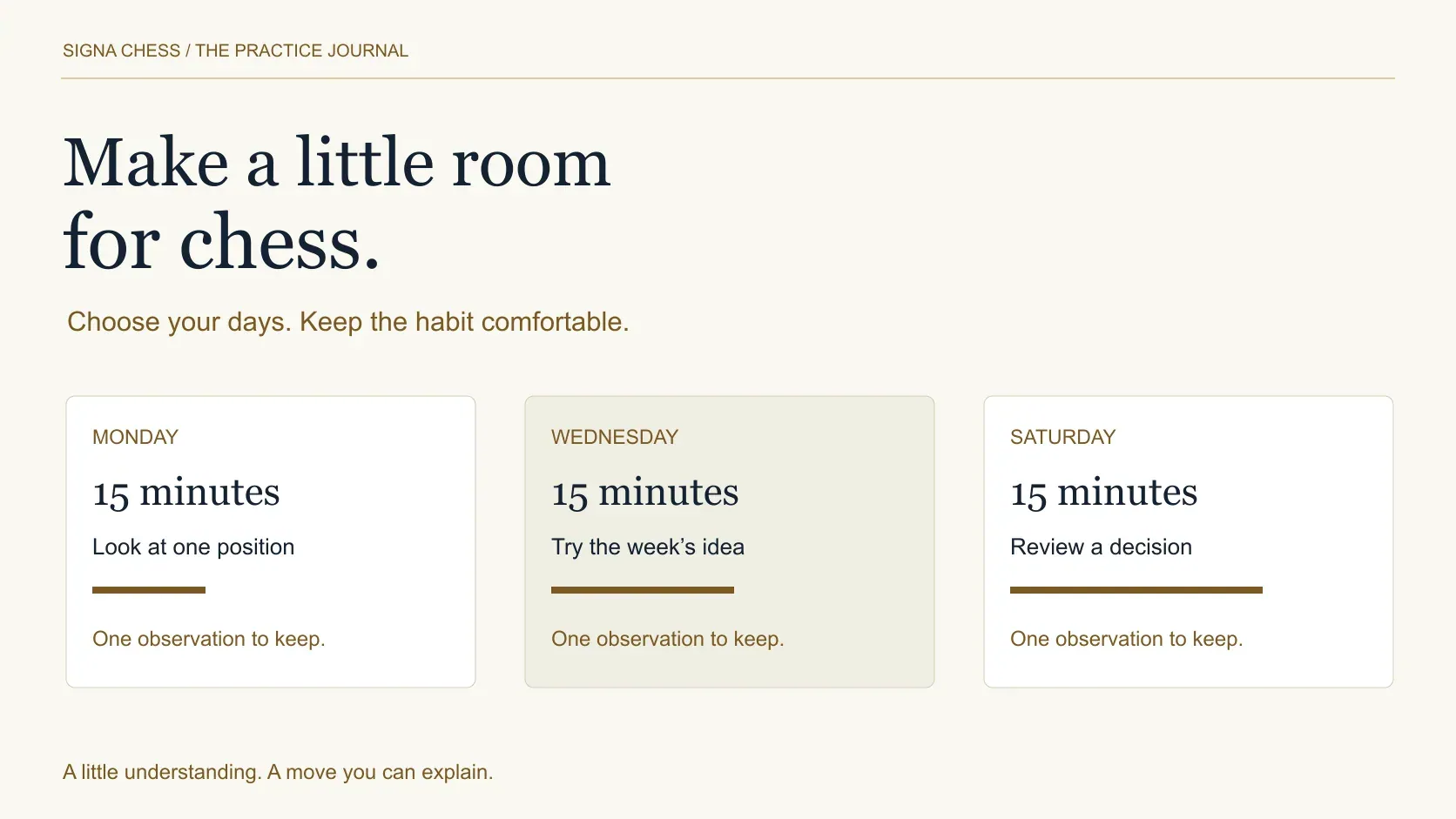
There is no universal number of hours that every child needs. Schoolwork, sports, rest, interest, and lesson schedules all matter. Instead of starting with an ambitious daily target, choose a few modest blocks that the family can repeat. A short puzzle session on one day, a longer game on another, and a quick review later can give practice several different purposes. If the student has only one free afternoon, use that time thoughtfully and avoid treating the calendar as a measure of commitment.
Set a start and a stopping point. A session can end when the planned activity is complete, even if the student has not exhausted every exercise. Leave some room for curiosity: a child might want to set up an interesting position or replay an exciting game. If practice repeatedly feels like a chore, reduce the load and ask what is not working. A steady, enjoyable habit is more useful than a demanding plan that creates arguments or displaces sleep and other healthy activities.
| Session | What to do | What to bring away |
|---|---|---|
| Lesson day | Focus on one idea with the coach. | One phrase or position to revisit. |
| Puzzle day | Solve a small set without rushing to reveal the answer. | One pattern you can explain. |
| Game day | Play one complete game at a comfortable pace. | A moment that felt difficult or interesting. |
| Review day | Look at one decision and write a short note. | A question to ask in the next lesson. |
Solve puzzles by explaining the position
Before touching a piece, describe what is happening. Is either king in danger? Which pieces are attacked? What checks, captures, or threats should you consider? Then choose a candidate move and calculate the opponent’s most sensible reply. A puzzle is not solved simply because the first move looks attractive. The point is to understand why the move works and what the position looks like after the response.
If you miss the answer, do not immediately move to the next puzzle. Find the step where your thinking went in another direction. Did you overlook a defender, assume a capture was forced, or stop calculating one move too early? Write a short explanation in your own words. You might say, ‘The bishop is protected, so the queen cannot take it,’ or ‘I missed the check on the back rank.’ A specific observation is easier to reuse than a red X on a score.
- Name the opponent’s threat before looking for your own idea.
- Calculate the likely reply to your candidate move.
- Explain the answer before checking a solution or engine.
Play games that leave room to think
Fast chess can be fun, but a beginner who plays only quick games may have little time to practise a new thinking habit. Choose a time control that leaves room to pause and check the position. The exact choice depends on the student and the purpose of the game; ask a coach what is appropriate. If you play online, use a setting the student understands and take a break when concentration fades. Practice should teach decision-making, not only fast mouse movement.
During the game, focus on one reminder from the week. Before a move, ask what changed after the opponent’s last turn. If the theme is piece safety, check attacked pieces and defenders. If the theme is an endgame, notice whether the king can become active. Do not try to follow ten rules at once. A single prompt gives the student a clear experiment: make a decision, see how the game responds, and return to that moment later for review.
Review one game before opening an engine
After the game, identify a moment that mattered to the student. It might be the first time they felt unsure, a move they were proud to find, or the position where their plan stopped making sense. Rebuild that position and ask what each player was trying to do. Let the student suggest a candidate move and explain a possible reply. This first pass helps preserve their own thinking before a computer evaluation introduces a number or a long variation.
Then use analysis tools as a question generator, not an answer sheet. If an engine marks a move as inaccurate, ask what threat or opportunity it sees. Check the line far enough to understand the point, then translate it into a lesson the student can use. Beginners rarely need to memorize a computer’s principal variation. They need to recognize the underlying idea—perhaps a hanging piece, a missed check, or a king that needed safety—and practise that idea in another position.
Keep notes short and specific
A practice notebook does not have to become another homework assignment. Record the date, the theme, and one sentence about what became clearer. A student might write, ‘I checked the opponent’s last move and saw the bishop was attacking my rook,’ or ‘I need to look for the king’s escape squares before I start a pawn race.’ Those notes can help a coach choose a useful next exercise and help a parent see what the child is thinking about, without tracking every puzzle score.
For a younger player, a drawing or screenshot of a position can work better than a paragraph. Label the key square or piece and explain the idea aloud. Keep student information private: do not post names, account identifiers, or identifiable games publicly without permission. The value of the log is in the reflection, not in publishing a progress report. Review it every few weeks and remove themes that no longer match the student’s actual needs.
Adapt the routine when life changes
A school break, exam period, tournament weekend, or change in family schedule can disrupt a routine. That does not mean the student has failed. Reduce the plan to one small activity, pause it for a week, or move the session to a better time. If the child returns after a gap, begin with an enjoyable familiar position rather than trying to make up every missed task. A flexible routine can restart; a guilt-based one often becomes harder to resume.
Notice when energy is low. A tired student may benefit from a light game or a short replay, while a more focused day can suit deeper calculation. Ask the child which part they like and which part feels heavy. If tournament preparation is coming, shift practice toward the event’s format and logistics rather than adding hours indiscriminately. For a first event, our tournament preparation guide can help families build a calm plan around the actual organizer’s instructions.
Bring a question back to the next lesson
Practice becomes more connected when it leads to a conversation. Bring one position, note, or question to the next class. Ask the coach to explain the moment in a way the student can try again, then ask what a similar practice position might look like. That loop—learn an idea, notice it in play, reflect, and ask a question—helps the student see lessons as part of their own games rather than separate information to memorize.
A coach can also help adjust the difficulty. If the puzzles are solved instantly without thought, choose a position with a less obvious candidate move. If the student cannot begin, reduce the position or offer a hint that guides attention without giving away the answer. Discuss how much independent practice fits alongside lessons and family life. The purpose is not to maximize activity at any cost. It is to give the student repeatable chances to think well, stay curious, and enjoy the game.
Parents can support this loop without becoming chess instructors. Help the child save a game or find a position again, ask what they remember, and let them describe the problem before offering an idea. If they cannot explain it yet, mark the question for the next class. Avoid turning every casual game into a lesson or correcting each move while the student is still deciding. A little space encourages ownership. Over several weeks, you may notice the student checks a threat on their own or asks a more precise question. Those observations are useful to share with the coach, even when the rating remains unchanged.
Keep the materials simple enough that a child can use them independently. One saved game, a notebook page, or a folder of a few positions is usually sufficient; a complex tracking spreadsheet can take more time than the practice itself. If the student is learning online, make sure the board can be reopened and the game record is saved in a place the family can find. Ask permission before sharing a student’s position publicly, and remove account names if you use a screenshot at home. Good practice should make it easier to think, not create new administrative work for the family.
Build a weekly plan that fits the time you have
The practice planner above asks for a starting point, a theme, the days available, and a comfortable session length. It creates a small routine with a familiar warm-up, focused work, and a closing observation. The total minutes shown apply to those planned sessions. They do not include a complete slow game: leave an unhurried game in a separate block when time permits, rather than trying to squeeze one into the final minutes of a short exercise session. A plan should describe the time your family has, not quietly demand more.
Choose movement and captures when the student is still learning the rules, noticing attacks when pieces are being left vulnerable, or a simple tactical pattern when the student is ready to explain a short sequence. These are broad starting choices, not a diagnosis of a child’s ability. Adjust the generated routine with a coach who has seen the student’s games. If the activity feels too difficult, return to how the chess pieces move; if the student understands movement but misses threats, try the safe-square trainer.
Keep a copy and review the plan after one week
Download the plan as a text file when you want to keep it, print it, or add a note beside each day. The page does not ask for contact details and does not save this practice plan to an academy account. Reloading clears the choices and generated result. That makes the tool quick to use for a new week: select the days again and change the theme if needed. If a day was missed, move or shorten the session with the family rather than stacking several missed sessions into an uncomfortable catch-up block.
At the end of the week, ask what the learner can explain more clearly. A useful change might be identifying Black’s pawn attacks, checking a queen’s destination, or recording a question from a game. Do not infer a rating improvement from the number of boxes completed or minutes spent. Compare the plan with what actually happened and make the next version easier to keep. You can use a position from the practice arena as the main task and bring the student’s explanation, including any uncertainty, to a later class discussion.
Keep it practical
What to take with you
- Set one theme for a week so practice connects to real games.
- Choose fewer positions and explain your thinking before checking answers.
- Use a realistic rhythm, then adjust it with your family or coach.