
Play a king and pawn ending
These are simplified positions with only the pieces needed for the example. Tap or drag a piece to its destination, or use the keyboard.
Position 1 of 2
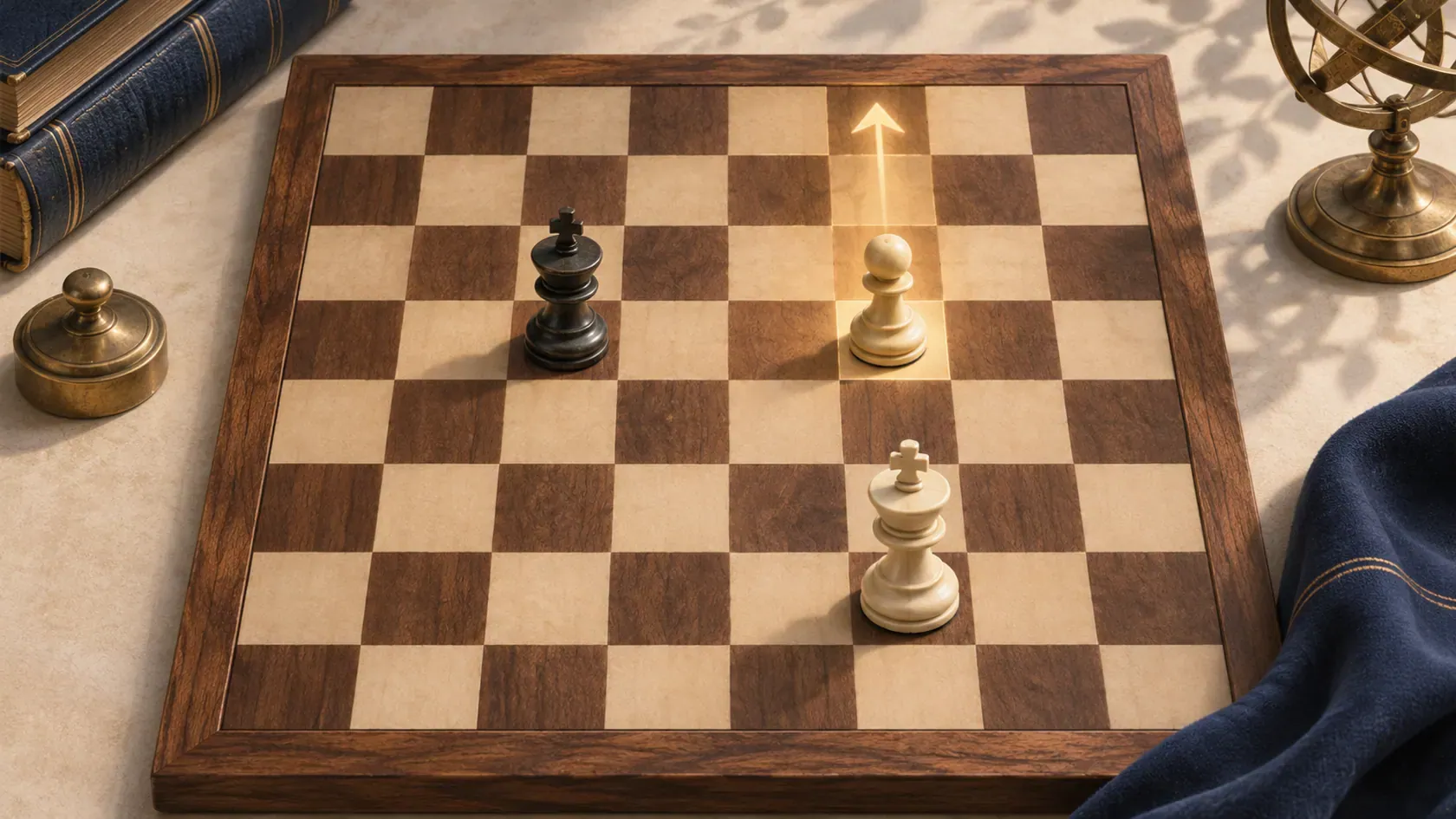
Promote the pawn
White to move: advance the pawn to its promotion square.
Select a piece, then select its destination.
These are teaching positions. Explore the explanation after making the move.
Start here
The quick answer
In a king-and-pawn ending, both kings can become active, and the pawn’s path to promotion depends on whose turn it is, how far away the kings are, and whether the pawn is supported. The square rule offers a quick way to estimate whether a lone king can catch a passed pawn, but it has conditions and does not replace calculation. Before pushing, check the king’s route, opposition, and the opponent’s legal replies.
Why the king changes role in an endgame
When queens and most pieces leave the board, the king often has more room to move. It can support its own pawn, approach an opposing pawn, or help block the enemy king. A beginner who has learned to keep the king safe in the opening may need to adjust: in a simplified ending, the king can become an active participant. The exact plan depends on the position, and king safety still matters when other pieces remain. In a pure king-and-pawn ending, checkmate is no longer possible with pawns alone against a bare king unless a pawn promotes.
A king-and-pawn ending can turn on one tempo. If both kings race toward a pawn or a key square, whose turn it is may decide whether the defending king arrives in time. That is why an endgame is not simply a slow game with fewer pieces. The board above lets you promote a pawn and practise bringing a defending king alongside an undefended pawn. Then the article adds king support and opposition. A student should set the pieces on a board and play the moves, because the same-looking position can change when the side to move changes.
The square rule as a quick test
The square rule is a shortcut for a specific kind of race: a passed pawn is advancing toward promotion, and the opposing king is the only defender trying to catch it. Imagine a square that begins at the pawn’s current square and stretches to its promotion square, with the same number of files and ranks. If the defending king can enter that square on its move, it may be able to catch the pawn; if it cannot, the pawn may promote. The exact calculation still matters, especially when the pawn is on its starting rank or the side to move changes the count.
For example, a pawn on e4 moving toward e8 has four ranks to travel if it advances one square at a time. The defender does not always need to move to e8; it can approach any square inside the pawn’s imagined catch zone. Count the king’s moves carefully and remember that the pawn may move two squares from its starting square only when the rules and position allow. The interactive activity uses sparse positions to make the counting visible. It is a learning aid, not a general tablebase or engine. If a king can capture or block the pawn, include that possibility in the actual line.
| Check | Why it matters |
|---|---|
| Is the pawn passed? | An opposing pawn on a neighboring file may block or capture it. |
| Whose turn is it? | The first move can decide whether the king enters the catch zone. |
| Can the pawn move two squares? | That option applies only from its starting square and if both squares are clear. |
| Is the king protected by its own king? | A supported pawn may force the defender to give way. |
Use the king to support the pawn
A passed pawn is a pawn with no opposing pawn on its file or neighboring files that can stop it by capturing. It may still be blockaded by a piece or the king. When your king can move in front of the pawn, it may clear a path and prevent the opposing king from stepping onto key squares. A common beginner error is pushing the pawn every turn while the king stays far away. Sometimes the king must come forward first. Sometimes the pawn needs to advance to gain space. Compare the candidates rather than following a slogan.
A useful board exercise is to put the kings and one pawn on a file, then play both sides. Ask whether the attacking king can approach without allowing the defender to blockade. If the pawn advances too early, it may be captured or stopped. If it waits too long, the king may arrive behind it. Change the side to move and replay the position. The result can reverse. The guide to piece values and trades explains why material count alone does not tell the whole story; king activity and pawn progress can decide a simplified ending.
Opposition: control the key squares
Opposition describes a relationship between kings, often when they face each other with one square between them. The player who is not to move may hold the opposition because the other king has to step aside, allowing the first king to move toward a key square. In a pawn ending, that tempo can let a king approach the pawn or escort it forward. This is an introductory description; diagonal and distant opposition also exist, and the best move depends on the pawn’s position and promotion square.
Use a small position to practise. Place the kings on the same file with a gap, then move one king and see which squares the other king can enter. The rule that kings cannot stand next to one another matters here. A learner should identify the square they want to reach before trying to “get opposition.” Sometimes the goal is to move the opposing king away; sometimes the attacking king must escort the pawn. If the position is not winning, the defender may aim for a blockade or stalemate. The correct plan follows from the specific squares, not from the term alone.
Promotion is a choice, not always an automatic queen
When a pawn reaches the farthest rank, it is promoted to a queen, rook, bishop, or knight of the same color. Beginners often promote to a queen by habit, and that is usually the simplest choice when no tactic changes the result. A knight promotion can give check or create a fork, and a rook or bishop promotion can sometimes avoid stalemate. The FIDE Laws of Chess describe promotion as part of the move to the last rank. A pawn cannot remain a pawn or become a king.
Before pushing a pawn to the final square, check the opponent’s king moves and possible captures. If promoting to a queen leaves the opposing king with no legal move while not in check, the result may be stalemate rather than a win. If a knight gives check, it may force a different response. The choice should be tied to the position. In a beginner lesson, show one example where a queen promotion works and one where a different piece changes the outcome. That teaches the rule and encourages the student to inspect the result after promotion instead of treating it as a victory animation.
Drawing resources: stalemate, blockade, and the square
A player who is behind can still have a draw. Stalemate occurs when the player to move is not in check but has no legal move. The FIDE Laws define stalemate as a drawn game. A defending king may also reach the pawn’s path and stop it, or the attacking side may be unable to make progress without allowing the pawn to be captured. A student should not resign a pawn ending based only on counting material; the king’s route and legal moves still matter.
The square rule can help identify whether a bare king is close enough to catch a pawn, but it does not cover every case. A friendly king may support the pawn, an opposing pawn may block it, or the pawn may be able to use its initial two-square move. The side to move changes the count. Stalemate may also arise after a promotion. The interactive activity uses simple positions to illustrate promotion and a king catching an undefended pawn. Treat the tool as practice for one concept; use a coach, current rule source, or tablebase for complicated tournament analysis.
Common beginner errors in pawn endings
One common error is pushing the pawn without involving the king. Another is moving the king away from the pawn when it should support it. Students may also count the square rule from the wrong rank, forget that the pawn moves in one direction, or assume the defender must approach the pawn rather than block its route. Ask the learner to point out the promotion square and trace the king’s path one step at a time. If the path becomes confusing, reset the position and add only one piece or pawn at a time.
A different mistake is rushing to promote while ignoring the opponent’s legal replies. The king may capture the pawn, enter a blockade square, or be stalemated by a queen promotion. These are calculation questions, not reasons to avoid learning endgames. Use one clear position, play it out from both sides, and record the line. The chess notation guide helps a student write down the moves, while the practice routine provides a short way to revisit a difficult position later in the week.
A calm way to study a king-and-pawn ending
Begin with the king and one passed pawn. Identify the promotion square, count how many moves the pawn needs, and use the square rule to estimate whether the defending king can catch it. Then play the line to verify the estimate. Add the attacking king and ask whether it can escort the pawn or take the opposition. Finally, set up a drawing try for the defender and look for a blockading square or stalemate resource. This order lets a beginner understand one idea at a time rather than evaluate an entire endgame in a single glance.
Keep practice short and finish with a sentence the learner can explain: “My king needs to get in front of the pawn,” or “The black king can reach the square.” If the child is preparing for a competition, ask the coach to select positions that match their current level. Signa’s group classes and tournament preparation sessions can be explored according to the student’s learning goals. No single endgame exercise predicts tournament results; the value is in learning to calculate a small position carefully and explain why a pawn can or cannot promote.
Keep it practical
What to take with you
- Use the square rule as a quick test for a lone king chasing a passed pawn, then calculate the actual moves.
- Bring your king toward the pawn or block the opposing king when the position allows.
- Check stalemate and promotion choices before assuming a pawn ending is won.