
Play through a trade
These are simplified positions with only the pieces needed for the example. Tap or drag a piece to its destination, or use the keyboard.
Position 1 of 2
Knight takes rook
White to move: capture the rook with the knight. Watch Black's reply.
Select a piece, then select its destination.
Values are a guide; king safety and tactics can change an evaluation.
Start here
The quick answer
A common beginner guide counts a pawn as 1, a knight or bishop as about 3, a rook as about 5, and a queen as about 9. These are rough teaching values, not official rules or a verdict on a position. Before accepting a trade, count what each side gives and receives, then check whether the pieces are defended and what the move changes. The king has no exchange value because checkmate decides the game.
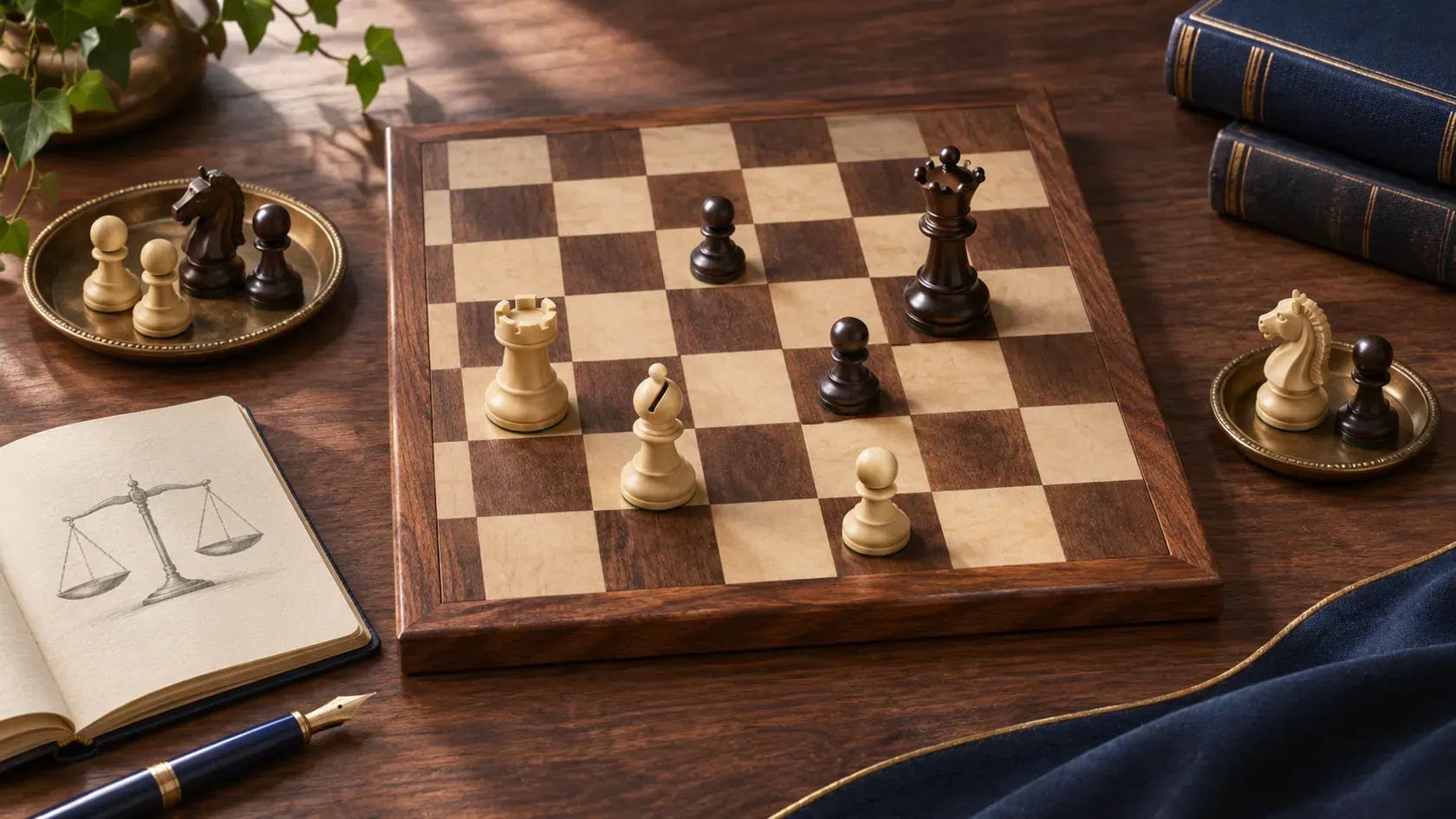
What chess piece values mean
Chess piece values are a teaching shortcut for comparing the material each side has. A familiar scale gives a pawn 1 point, a knight 3, a bishop 3, a rook 5, and a queen 9. The king is not placed on this scale: losing it to checkmate ends the game. The values can help a beginner notice that a queen is usually more costly to give away than a pawn, but they do not measure the entire strength of a position. The US Chess Trust beginner coaching guide presents piece values as a way for students to compare material and become more careful with their pieces.
The word “about” matters. A knight and bishop are often given the same classroom value, yet one may be more useful than the other in a particular position. A rook can be strong on an open file, while a bishop may have few useful diagonals behind locked pawns. A queen with many squares may still be vulnerable to a simple attack. The point scale helps organize a first conversation about trades; it does not replace seeing the board. When a child asks whether a move “wins three points,” ask which pieces remain after the exchange and whether either side has a follow-up.
| Piece | Typical point guide | Important limit |
|---|---|---|
| Pawn | 1 | A passed pawn near promotion can be far more urgent. |
| Knight | About 3 | Its value depends on useful outposts and available routes. |
| Bishop | About 3 | Open diagonals can make it more active. |
| Rook | About 5 | Open files and the endgame can change its role. |
| Queen | About 9 | Its activity and safety matter as well as its points. |
Play through a trade before judging the position
Play the capture on the board above and watch the recapture. Count the pieces that leave the board for each side using the common 1–3–3–5–9 guide, then read the explanation. These examples illustrate material rather than a complete engine evaluation: king safety, development and tactics can change the judgment of a trade.
For a real game, write down the full sequence before doing the sum. If your bishop captures a rook and the opponent recaptures that bishop, you have not simply “won a rook”; both pieces have left the board. If a queen captures a rook and is then captured by a pawn, the queen’s loss matters too. The material balance after the exchange is more useful than celebrating the first capture. Our safe-square trainer practises checking what an opponent can capture next, which is the natural partner to counting a trade.
Count the whole exchange, not the first move
Imagine a white bishop takes a black rook and a black pawn takes the bishop back. White received a rook worth about five and gave up a bishop worth about three, so the simple material count is roughly two points in White’s favor. That arithmetic assumes the pawn recapture is legal and no other piece changes the sequence. If the rook was defended by a queen or the capture exposes a king, the position may have additional consequences. Count the pieces first, then return to the board to ask what the exchange opened or weakened.
Now reverse the example: a rook captures a bishop and a pawn recaptures the rook. White gave a rook for a bishop, a rough loss of two points by the beginner scale. Yet there are positions where a rook is trapped, a king is about to be mated, or a tactical sequence wins more material later. Do not teach the numbers as a rule that every exchange must be equal. Instead, let the learner say what is being exchanged and what they expect to gain. A clear reason makes it easier to review the move after the game, even when the calculation was incomplete.
- List the capturing piece and its target.
- Check whether the target is defended and can recapture.
- Add every likely capture in the sequence before comparing totals.
- Finally ask what changed besides the material.
Why equal points do not always mean an equal trade
A bishop and a knight both count as about three points, but the board can favor one. An open position with targets on both wings can give a bishop long diagonals. A blocked position may give a knight safe squares that a bishop cannot reach. Two bishops can cover both colors; a pair of knights may be more useful in another position. These observations are not exceptions to memorize before a child learns the basics. They are reasons to avoid saying that a three-for-three trade is automatically good just because the material count balances.
The same issue appears in pawn exchanges. A pawn is one point on the scale, but removing a central pawn may open a file, clear a diagonal, or leave a weak square. A pawn that has advanced safely toward promotion can demand attention. A doubled or isolated pawn may be harder to defend, though that judgment depends on the rest of the pieces. Ask what square, line, or target changes after the capture. This shifts the discussion from a number to a visible feature that the learner can point out on the board.
A safer checklist before accepting a capture
Before moving, check the opponent’s threat and the square where your piece will land. A piece can capture something and still be captured in return. Ask whether the capturing piece is protected, whether a recapture is available, and whether the move leaves the king exposed. A simple count often catches a hanging queen or an obvious lost exchange, but a check or a mating threat can change the order of priorities. If the position is complicated, choose a candidate move and calculate the opponent’s strongest reply rather than relying on the point scale alone.
For a young player, keep the questions in a stable order: What can I take? What can they take back? What did my move stop defending? Does either king face an immediate threat? One specific observation is enough to begin. If the child is learning the names of attacks, the beginner tactics guide explains why a piece may be pinned or attacked twice. A missed tactic can make a simple material count misleading, so the routine should include both numbers and the board’s geometry.
Material can matter less than the position
A player can be ahead in points and still be in danger. Their king may have no safe squares, their pieces may be trapped, or an opponent’s pawn may be close to promotion. A player can also be behind material but have a strong attack or a drawing resource. Those are more advanced evaluations than the board examples attempt. Beginners can first learn to keep a piece safe, see a recapture, and recognize when a king is under attack. As understanding grows, the coach can add activity, pawn structure, king safety, and the possibility of a forced tactic.
This is one reason an engine’s decimal evaluation is not a material score. The evaluation reflects its analysis of the position and may include king safety, piece activity, pawn structure, and forced lines, not only the number of pieces. It can also change with depth as the engine searches farther. A child reviewing a game should first explain the idea they saw and the reply they missed. Then an engine or coach can help compare alternatives. The US Chess ratings guide also cautions families to read a chess number in context; no single score describes every part of a player’s understanding.
Teach piece values without making every game a transaction
Introduce the scale during short, simple positions. Show a pawn, a knight, and a rook, then ask which one is generally more valuable by the beginner guide and why protecting a queen matters. Next, show a trade where both sides receive something back. Let the student count the sequence with physical pieces or the board above. If they give the wrong answer, rearrange the pieces and count again. The teaching goal is to notice a consequence, not to judge the child for losing material in a real game.
After the activity, play a complete game without stopping on every exchange. At the end, choose one moment where a trade changed the position and ask what each side received. A child may notice that a bishop was active, a rook was trapped, or a pawn advanced. Save that observation and revisit it later. Signa’s small-group classes create room to explain a move and hear another player’s idea, while private coaching can focus on an individual game when that format fits the learner’s goals and schedule.
A practice sequence for making better trades
For the first practice, learn the rough values and solve two simple capture sequences. For the next, look at a game position and identify which pieces are attacked. Then review a trade from a real game, including the recapture. On a later day, compare two minor-piece trades and talk about which piece is more active. Keep the tasks short, and stop when the learner starts guessing. The weekly practice planner can help divide a week into small sessions without turning every practice day into a material worksheet.
No point system can tell a student which move to play in every position. Use it to ask a clearer question: “What am I giving and what am I receiving?” After that, look for the opponent’s reply and the role each piece will have if it stays. If the learner can explain one trade in their own words, the numbers have done their job. A coach can then choose a position where activity, king safety, or a tactical idea matters more than the simple count. This gradual approach keeps material from becoming a substitute for chess thinking.
Keep it practical
What to take with you
- Use 1–3–3–5–9 as a quick material reminder, not an automatic move selector.
- Count the full exchange, including recaptures, instead of comparing only the first capture.
- Ask what the pieces do in the current position before calling a trade good or bad.