
Start here
The quick answer
Rooks move straight, bishops move diagonally, queens combine both, knights jump in an L shape, and kings normally move one square. Pawns move forward but capture diagonally. The board activities below let you try each pattern. After learning the shapes, check for blockers and whether a move leaves your king in check: movement patterns and legal moves are related, but they are not always the same.
Learn how the pieces move
Select a piece, then select its destination. You can also drag, or use arrow keys and Enter on the board.
Activity 1 of 7 · Take your time
Rook
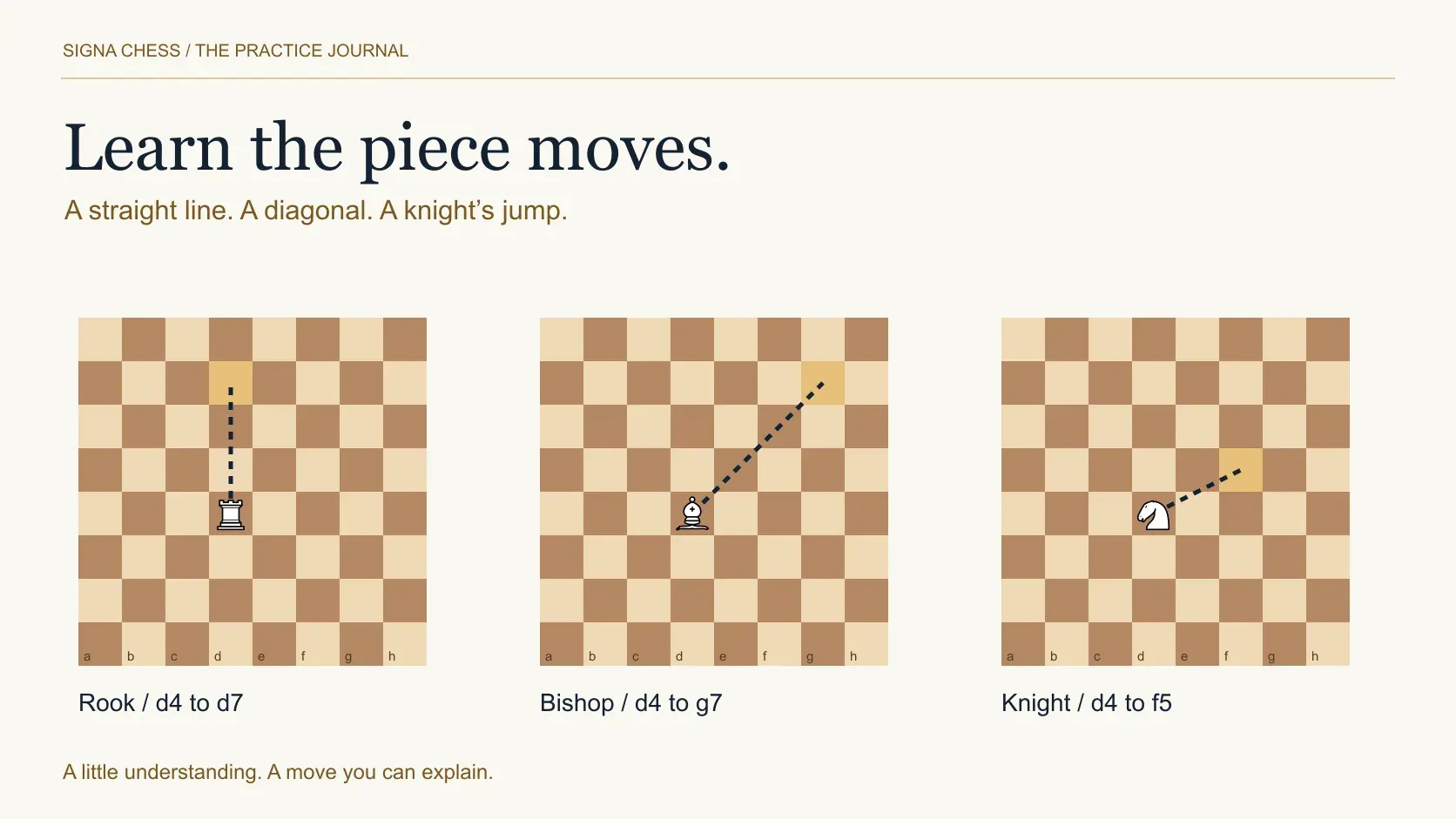
Move the rook from d4 to d7.
Select the named piece to begin.
No timer or rating. A mistake is a chance to look again.
Set up the board before learning the moves
Place a chessboard so the corner nearest your right hand is a light square. That rule works from either player’s side. From White’s viewpoint, the bottom-left square is a1 and the bottom-right square is h1. The letters a through h label files, which run vertically; the numbers 1 through 8 label ranks, which run horizontally. When someone says e4, find the e-file and the fourth rank. The two meet at a single square. Saying the square aloud while pointing to it helps connect the name with its location.
Each player begins with sixteen pieces. On White’s back rank, place the rooks in the corners, then knights, then bishops, with the queen on d1 and king on e1. Black’s matching pieces go on rank 8, with the queen on d8 and king on e8. The queen begins on her own color: White’s queen on a light square and Black’s queen on a dark square. Pawns fill the rank immediately in front. White moves first. For a very young beginner, start with fewer pieces when practising a movement pattern, then rebuild the complete starting position together.
A quick reference for all six piece types
Use this table as a reminder after trying a piece, rather than asking a child to memorize every row before touching the board. A movement pattern describes how a piece travels. A position adds other conditions: occupied squares, an opposing attack on your king, and sometimes special rights such as castling. Apart from a knight’s jump and the special castling move, pieces cannot pass over other pieces. You cannot finish a move on a square occupied by one of your own pieces.
When a piece captures, it normally lands on the opponent’s square and that opposing piece is removed. Pawns need special attention because their straight move and diagonal capture differ. The official FIDE Laws of Chess set out the rules of movement and king safety. The explanations here focus on learning those ideas at a board; competitive events may also have their own procedures for clocks, notation, and resolving a disputed move.
| Piece | Movement | Common beginner mistake |
|---|---|---|
| Rook | Along a rank or file | Trying to move diagonally |
| Bishop | Along a diagonal | Changing square color |
| Queen | Along a rank, file, or diagonal | Jumping over a blocker |
| Knight | Two squares one way, one at a right angle | Treating the path as sliding movement |
| King | One adjoining square, with a special castling option | Moving onto an attacked square |
| Pawn | Forward; captures diagonally forward | Capturing straight ahead or moving backward |
Rooks follow ranks and files
A rook can move any available distance horizontally or vertically. Put a rook on d4 and trace the d-file up and down, then the fourth rank left and right. On an otherwise open board, d7 is a movement-pattern destination and g4 is another. A square such as f6 is not on either line. Ask the learner to point to the entire line before choosing a destination. This is often easier than giving a long verbal description while the child tries to remember the starting square.
Next, add a friendly pawn on d6. The rook cannot move through it to d7, and it cannot capture its own pawn. Replace that pawn with an opposing piece: the rook may capture on d6 if the move is legal, but still cannot pass through that piece to d7. This introduces a useful habit for every sliding piece: scan the line, find the first blocker, and decide whether it is friendly or opposing. Return to the tool’s rook activity and explain why d4 to d7 works in that particular open position.
Bishops stay on diagonals
A bishop travels diagonally and stays on the same square color throughout the game. From d4, one diagonal passes through e5, f6, and g7; another reaches c5, b6, and a7. Have the child trace a diagonal by moving one file sideways and one rank forward at each step. If the bishop starts on a dark square and the proposed destination is light, the movement pattern is wrong. Square color is a helpful early check, although matching colors alone does not prove that two squares share a diagonal.
A bishop cannot jump a pawn in its path. Place a friendly pawn on e5 and ask which direction is blocked. The bishop can still use other open diagonals. This is a useful first look at how pieces affect one another: the pawn is legal on e5, but it reduces the bishop’s options. Avoid turning this into an advanced strategy lecture. The immediate learning goal is simply to recognize a diagonal, spot a blocker, and demonstrate a legal bishop move without relying on a highlighted destination.
Queens combine the rook and bishop patterns
A queen can travel along a rank, file, or diagonal. Place one on d4 and compare three proposed destinations: d7 follows a file, g4 follows a rank, and a7 follows a diagonal. All follow the queen’s movement pattern on an open board. A destination such as f5 does not. The queen’s many options can be distracting for a new learner, so practise one line at a time. Ask, “Which straight line connects these squares?” before inviting the child to move the piece.
The queen cannot jump over a blocker, and her strength does not protect her from capture. After a correct movement exercise, put a black pawn where it attacks the destination. Explain that reaching a square legally and reaching it safely are different questions. A beginner should learn both, but does not need to solve a difficult tactical puzzle while still learning the movement shape. Our guide to avoiding hanging pieces introduces the destination check with a separate set of relaxed board activities.
Knights jump to a different square color
A knight moves two squares in one direction and one square at a right angle. From d4, f5 is one destination and e6 is another. Think about the final square rather than asking the learner to slide the knight through each step: the knight jumps, so pieces between its starting and ending squares do not block it. Its destination still cannot contain a friendly piece, and a legal move must leave its own king safe. A knight changes square color on every move.
Try a simple comparison. Surround a rook with friendly pawns and it may have no available route. Put a knight in a crowded starting position and it may still jump out. Then place a friendly piece on one of the knight’s destinations to show the limit of the jump rule. Some children prefer counting two-and-one, while others recognize the eight surrounding destination squares as a pattern. Use whichever explanation helps them demonstrate the move accurately. Repetition from a different starting square matters more than how quickly they solve the first example.
Pawns move forward and capture diagonally
White pawns move toward higher rank numbers; Black pawns move toward lower ones. A pawn normally advances one square into an empty square. From its starting square, it may advance two if both squares are empty. It cannot advance into an occupied square, even when that square contains an opposing piece. Put a white pawn on d2: d3 is its single move, and d4 is available for the initial two-square move if the way is clear. Once it has left d2, it does not regain that two-square option.
A pawn captures one square diagonally forward. A white pawn on d4 can capture a black piece on c5 or e5; it cannot capture a piece directly in front on d5. A black pawn on d4 instead attacks c3 and e3. Teach both colors deliberately, since children often learn White’s direction first and apply it incorrectly to Black. The tool includes separate pawn-move and pawn-capture activities. When practising away from the screen, swap the colors and ask the learner to explain why the direction changes.
Two further pawn rules can wait until the ordinary moves feel comfortable. Promotion happens when a pawn reaches the farthest rank and is replaced with a queen, rook, bishop, or knight of the same color. En passant is a special, immediately available capture after a neighboring opposing pawn advances two squares past a pawn’s capturing square. Demonstrate that rule on a board with the previous move included; an isolated diagram without move history can make the permission impossible to determine.
Kings need a safe destination
A king normally moves one square in any direction. Unlike other pieces, it must never move into an opposing attack. Two kings therefore cannot stand on neighboring squares. Begin with a sparse position and point to the opposing king’s surrounding squares. Then add a rook or bishop and trace its attack. The child should be able to say which proposed king destinations are unavailable and identify the attacking piece. A highlighted board can help check an answer, but invite an explanation before relying on the highlight.
Check means the king is attacked. A player in check must respond with a legal move that removes the attack, which might be a king move, a capture of the attacker, or an interposition against a sliding attack. Some checks cannot be blocked, including a knight’s check. Checkmate means the checked player has no legal response. A king is never captured. Stalemate is different: the player to move is not in check and has no legal move. Teach these endings with small positions so the distinction stays visible.
Learn castling after the ordinary king move
Castling combines a king move with a rook move and has additional conditions. In the standard starting arrangement, the king moves two squares toward a rook, and that rook lands on the square the king crossed. The king and that rook must not have moved previously, the squares between them must be empty, and the king cannot be in check or cross or land on an attacked square. The rook being attacked does not, by itself, forbid castling. A moved rook or king does not regain the right by returning to its starting square.
Use a prepared position with the move history or castling rights stated, then compare an allowed castle with a blocked one. Avoid telling a child that clearing the pieces between king and rook is the only requirement. It can create a persistent misunderstanding when they later try to castle out of check. The movement trainer above concentrates on ordinary moves and pawn captures; castling is a separate skill to practise after the child can recognize attacks and understand why the king’s route matters.
Turn the movement activities into a comfortable routine
Start with one piece and let the student choose several destinations. Ask for the reason before giving the answer: “Does it share a file, rank, or diagonal?” is a useful question for a rook or bishop. For a knight, ask the child to name the destination and demonstrate the jump. If the child is still learning coordinates, point to a square first and introduce its name afterward. Accuracy and comfort are more useful goals here than a timed score or completing every activity in one sitting.
Move from an empty-board exercise to blockers, then to captures, then to a short game. Use the weekly practice planner to leave space for each step. A child who knows all six movement descriptions may still need help spotting an attack in a full position. That is a normal next teaching task, rather than proof that the earlier learning failed. If you are considering lessons, the guide to a first chess lesson explains how to share what your child can already do and ask for an appropriate starting point.
- Try a piece from two different starting squares.
- Add one friendly blocker, then one opposing piece.
- Practise Black’s pawn direction as well as White’s.
- End with a short explanation of a move the learner chose independently.
Keep it practical
What to take with you
- Learn one movement pattern at a time, and say the starting and destination squares.
- Pawns have different movement and capture rules; check the direction for each color.
- A legal move must leave your own king safe. Use the board activities to practise, then try a complete game.