
Your first-tournament planner
Use the official event listing beside this checklist. “Not sure” is a useful answer: we’ll show what to ask the organizer.
What does G/30; d5 or G/30 +5 mean?
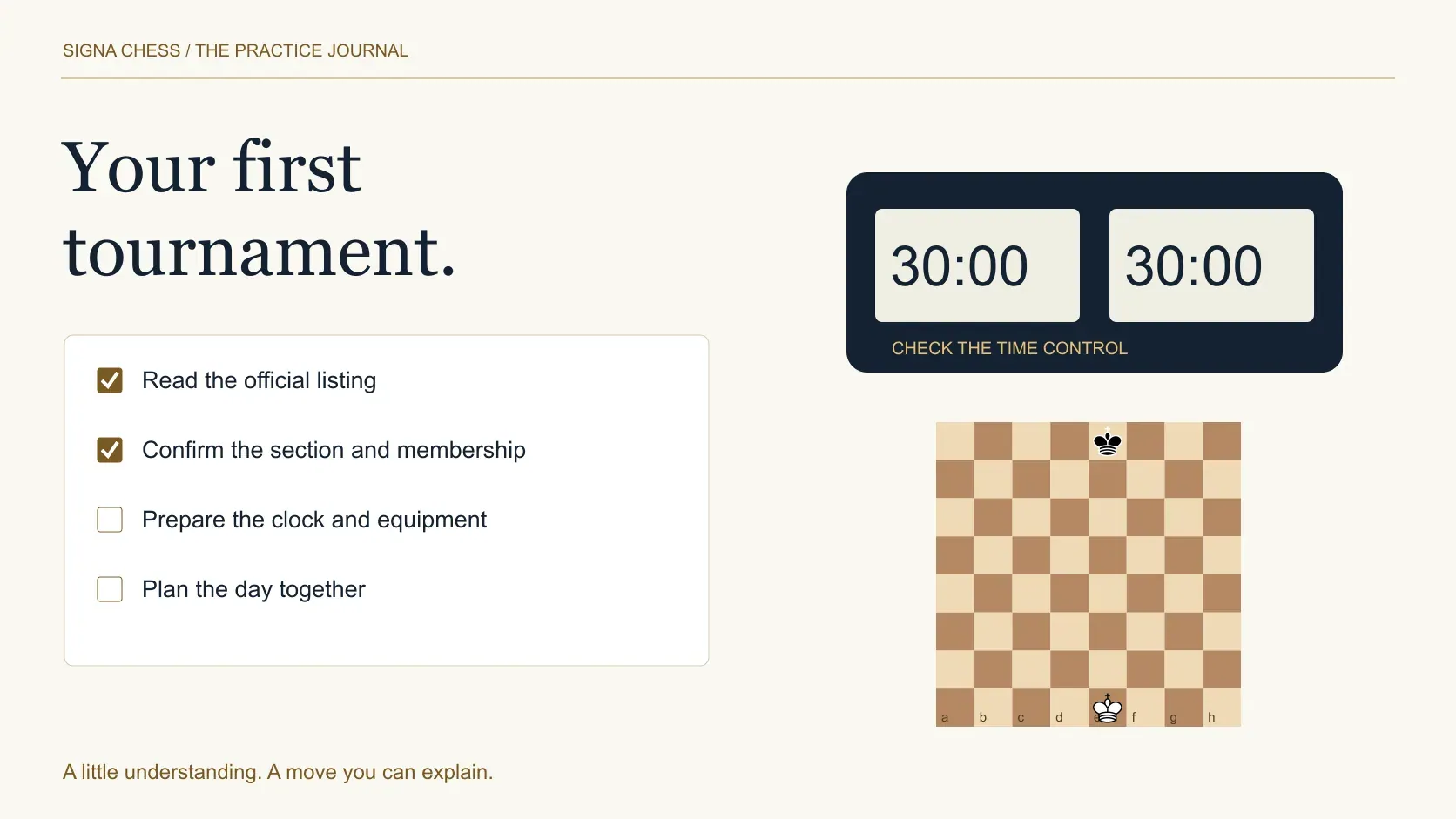
Each player starts with 30 minutes. A 5-second delay passes before the player’s main time starts counting down on each move; unused delay does not accumulate. Confirm the exact notation and clock setup in the event listing.
Start here
The quick answer
Start with the tournament organizer’s current listing: confirm the date, section eligibility, time control, schedule, equipment, and any membership or notation requirements. Practise a complete game with enough time to think, plan travel and breaks, and agree on a learning goal with your child. Event procedures differ, so ask the organizer or tournament director when a rule is unclear. Treat the result as one day of experience, not a verdict on your child’s potential.
Choose a first event for the experience
A first tournament does not have to be the largest event on the calendar. A nearby one-day scholastic event, a school club tournament, or a short local competition may provide a manageable first experience. Consider travel time, the number of rounds, the playing schedule, and how your child handles a busy day. Ask what the event feels like for a new competitor. A supportive environment and understandable logistics can matter more than a prestigious name or an ambitious section label.
Talk with your child about why they want to play. They may want to try a clock, see how pairings work, meet other young players, or test an opening idea from class. Agree on one goal they can control, such as checking every move before pressing the clock or writing down moves when required. Winning a trophy is not fully within their control. A process goal makes it easier to recognize useful effort, even if the event includes mistakes, a difficult pairing, or a result that surprises them.
It can help to attend as a spectator before registering, when the organizer permits visitors. The student can see how quiet the playing room is, where players wait, and how pairings are posted. Explain that rounds may take longer than a casual game and that players usually cannot talk with parents while a game is underway. If attending is not practical, look at the organizer’s photos or player guide together and ask the director what a first-time family should expect. Familiarity with the routine can reduce surprises without making the event feel like a high-stakes performance.
Read the event listing carefully
Tournament listings are compact, but every line can affect the day. Confirm the venue or online platform, start and end times, registration deadline, number of rounds, section names, eligibility, time control, entry fees, and withdrawal or refund policy. Check whether the listed time is local to the venue. Our tournament directory or a social post can help you discover an event, but the organizer’s current page is the final place to confirm information before traveling or paying. For national scholastic events, read the applicable current US Chess scholastic regulations alongside the event notice; local organizers may have separate rules.
Look for instructions about equipment, notation, food, spectators, check-in, and who may enter the playing area. Some organizers provide boards and clocks; others expect players to bring one or more items. Some events use specific membership or eligibility requirements. If the listing is incomplete, contact the tournament director with a concise question before registering. Do not infer a rule from another tournament with the same name or from a past year. Event details can change, and a current written answer gives your family something dependable to follow.
- Which section can my child enter under this event’s rules?
- What is the round schedule and when should players check in?
- What equipment, membership, notation, or parent instructions apply?
Choose a section with the organizer’s help
Section names such as Open, Under 800, K–8, or unrated do not mean the same thing at every tournament. An age or grade section might be based on school grade, age on a particular date, or a set of event rules. A rating section may use a cutoff, and organizers can publish additional eligibility conditions. Use the current listing and official regulations that apply to that event. If your child has no rating or has ratings from several systems, ask the director which information the event uses.
The goal is a fair and enjoyable competitive setting, not the easiest possible field or the highest section available. A coach can discuss what the child has practised and whether the format suits their experience, but the tournament director determines eligibility under event rules. Do not enter a section based only on a friend’s advice or a search result snippet. Our guide to choosing a section for an unrated child explains the questions to ask without treating national scholastic policy as a universal local rule.
Practise the game-day routine
Play a complete practice game at a similar time control if you can. Let the student practise starting the clock on the correct side, pressing it after a move, keeping both hands clear when appropriate, and using the clock without rushing. If notation is required, practise recording moves at the board. If the event uses a digital platform, test the device, connection, and any rules about cameras or assistance. These details are easier to learn calmly at home than during an unfamiliar first round.
Review the event’s actual rules with the student in age-appropriate language. Explain that the tournament director is the person to call when there is a dispute or uncertainty. Children should know not to accept outside help during a game and to follow the event’s instructions about phones, talking, touching pieces, and leaving the board. Avoid giving a long lecture on every obscure edge case. Practise the routines the organizer lists and remind your child that asking the director politely is better than guessing.
Plan travel, food, and the schedule
Work backwards from the check-in time. Consider traffic, parking, venue entry, and how long it takes to find the playing area. Keep the organizer’s phone number, event page, and schedule accessible. If multiple rounds are spread across a day, check when players may leave the venue and whether parents need to remain nearby. For online events, agree where the student will play and who can help with technology without interfering with the game.
Pack water and food that fit the venue’s rules. A child may not be able to eat at the board, and some buildings restrict food or have limited nearby options. Plan for breaks between rounds without treating every pause as a lesson. A quiet walk, restroom break, and time to reset may help more than immediately analyzing a loss. If the event is long, bring a book or calm activity for waiting. Keep the schedule realistic and make sure your child gets normal sleep the night before.
Support without coaching during play
Before the round, wish your child well and remind them of the goal you agreed on. Once play begins, follow the event’s spectator and communication rules. Do not signal a move, discuss a position, or use a phone in a way the tournament prohibits. Even a well-meant gesture can distract a child or create a fair-play concern. If you are uncertain where parents may stand or when a player can speak with you, ask the organizer before the round starts.
After a game, let your child decide whether they want to talk immediately. A simple question such as ‘Would you like a break or would you like to tell me about it?’ gives them control. Avoid asking first whether they won, whether they made a blunder, or why they did not choose a particular move. The student may still be processing the game. Make food, water, and the next check-in the priority; detailed chess analysis can wait until it is permitted and the child is ready.
Read the result in context
A tournament result combines many things: the opponent, the position, the time on the clock, nerves, new procedures, and decisions made during a game. One score cannot tell you everything about a child’s chess strength or what they learned. Ask what felt familiar, what felt different from practice, and which moment they would like to understand. The answer might be a good move, a time-management choice, or a confusing instruction—not necessarily the final position.
The pairing list can also put a first-timer across from someone who has played more events, even when their section is appropriate. Ratings and section labels are tools used by an organizer; they cannot make every game feel evenly matched. A difficult opponent can expose an idea the student has not met before, while an easier game may give them time to practise a routine. Neither pairing defines future potential. If the child asks why a result happened, help them return to a concrete moment in the game rather than inventing a story about talent or effort from one score.
If your child loses, resist turning the trip home into an evaluation. Acknowledge the feeling without pretending the result does not matter to them. When they are ready, choose one position to review together or with a coach. If the child wins, celebrate while also leaving room to explore decisions that could improve. Keep praise specific: preparation, thoughtful effort, good sportsmanship, or asking for help at the right time. That approach helps competition stay connected to learning rather than becoming only a verdict.
Review and decide what comes next
After the event, save the games, pairing results, and notes the organizer provides. Give your child time to rest before reviewing. Later, compare one or two moments with what they practised. Did the clock feel manageable? Was the section appropriate? Did the child understand how to find the playing area and follow the round instructions? A practical review can highlight one thing to keep and one thing to prepare differently next time, without requiring a full engine report for every game.
Then ask whether your child wants to play again and what kind of event sounds appealing. A next tournament should fit their interest, schedule, and learning goals. If a detail was confusing, contact the organizer rather than relying on memory. For packing, use our scholastic tournament checklist; for membership questions, see US Chess membership before a first event. A calm first event can become the foundation for a longer, more enjoyable chess journey.
Use the first-tournament planner beside the event listing
The first-tournament planner above turns preparation into a short checklist you can work through with the organizer’s current page open. Select whether the section is rated or unrated, whether eligibility has been confirmed, what you know about membership, and whether equipment is supplied. Choosing “not sure” is useful: it identifies a question to resolve before paying or traveling. The result is a preparation list rather than a registration form. You do not enter a child’s name, rating ID, address, or contact details to use it.
Work through the generated items and download a text copy when you want to keep the list. Checkmarks on this page clear when it reloads, so download before closing if you need your progress later. A completed checklist does not confirm a section placement or reserve a tournament spot. Keep the organizer’s registration confirmation separately. If your question is specifically about an unrated student, read which section an unrated child should enter, then ask the director to apply the actual event’s rules to your child’s circumstances.
Read the time control without confusing delay and increment
A listing such as G/30 describes a game in which each player has thirty minutes of main time. An added delay or increment changes how the clock behaves. With a five-second delay, the main time does not start decreasing until that delay has passed on the turn; unused delay does not accumulate. With a five-second increment, time is added for each move according to the event’s clock-setting procedure. The planner’s expandable clock explainer lets you compare these settings in plain language. It illustrates a single time control, not every possible multi-stage tournament format.
Do not use a familiar-looking clock preset without checking the event’s instructions. Time-control punctuation and clock interfaces can differ, and a longer game may have additional stages. Ask a director to confirm the setting before play if uncertain. For national scholastic events, US Chess helpful resources include clock and notation material, while the official rules resources provide a route to rulebook information. Event-specific instructions remain the place to confirm what applies on the day you attend.
Keep it practical
What to take with you
- Read the current event page and ask the tournament director about anything unclear.
- Practise the clock, notation, and routines the specific event requires.
- Plan food, travel, breaks, and a supportive post-game conversation.