
Start here
The quick answer
Before moving, look at the opponent’s last move, identify immediate attacks, and check the square your piece will land on. A piece can move legally and still be captured for free. In the trainer below, rescue a named piece from an immediate attack; several moves may satisfy the task. These small exercises teach one safety habit, rather than estimate a rating or identify the strongest engine move.
Find a safe square
White to move. Rescue the named piece from an immediate attack. More than one move can work.
Activity 1 of 6 · Take your time
Follow the diagonal
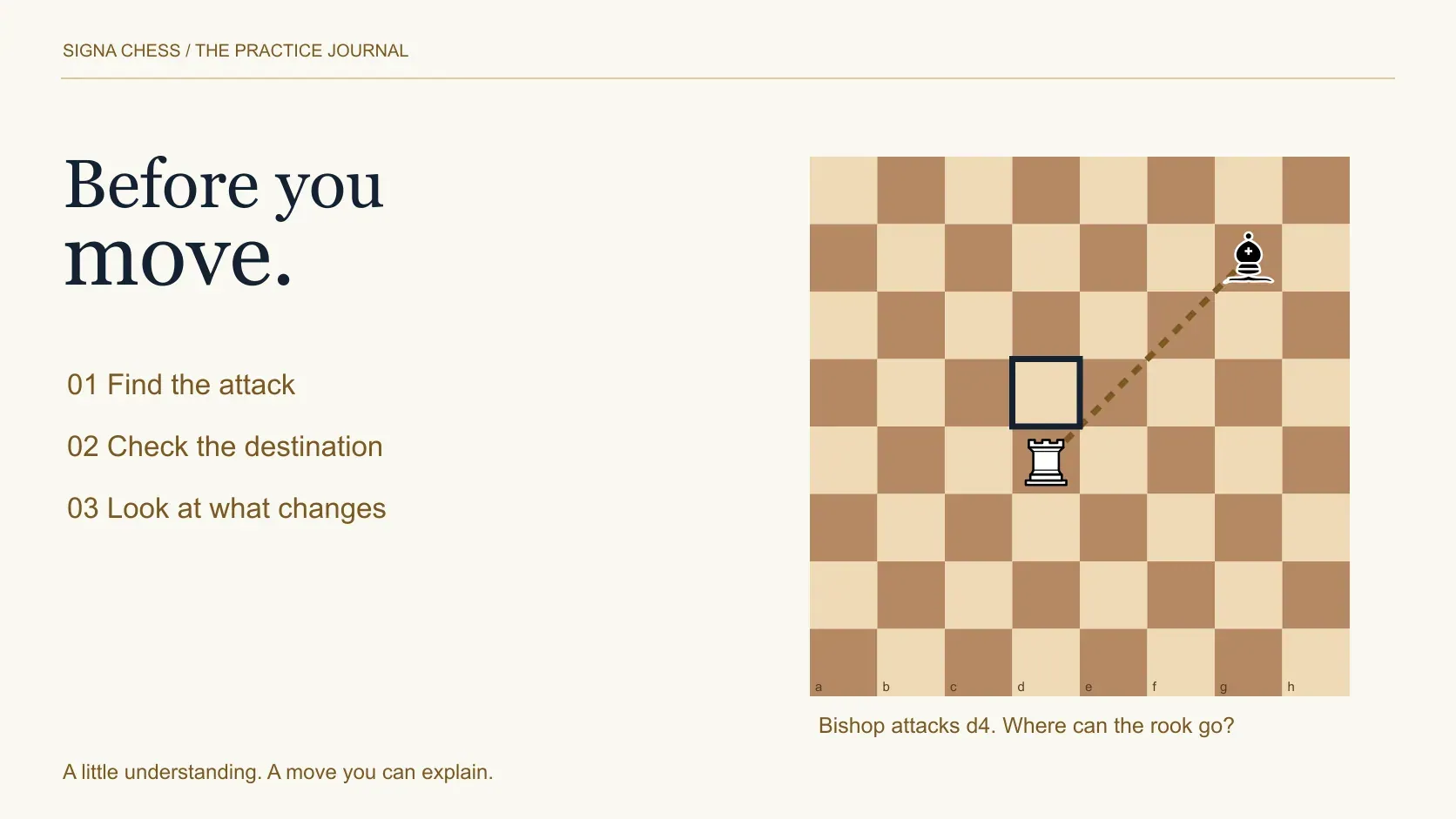
Move the rook on d4 to a square Black does not attack.
Select the named piece to begin.
No timer or rating. A mistake is a chance to look again.
What does hanging a piece mean?
A hanging piece is generally a piece that can be captured without adequate compensation, often because it is undefended or insufficiently defended. In a simple example, a rook sits on the same open diagonal as an opposing bishop and no friendly piece can recapture that bishop after it takes the rook. The rook is under an immediate threat. The practical question is whether your opponent can make that capture on their next turn and come out ahead. Recognizing this situation does not require memorizing a long opening line.
Being attacked is not the same as being lost. A defended piece may be safe, a capture may allow a stronger reply, or a sacrifice may be deliberate. At beginner level, start with clear positions where a valuable piece is attacked and can move away. The Lichess hanging-piece puzzle theme also focuses on undefended or insufficiently defended material. Our trainer approaches the pattern from the defending side: identify the danger and move the named piece to a square Black does not immediately attack.
Why a legal move can still be a mistake
Chess rules determine whether a move is allowed. They do not guarantee that the move protects your material. A queen can move to a square attacked by an opposing pawn, provided the move does not leave its own king in check. A king cannot make the equivalent move onto an attacked square. This difference matters when a beginner treats a digital board’s legal-move dots as a safety recommendation. The dots show permission, not a promise that the move is good. Always inspect the opponent’s possible reply.
The tool deliberately distinguishes those two checks. An illegal move receives a rules explanation. A legal move to an attacked destination leaves the position unchanged and asks the learner to look again. A legal move that meets the activity’s safety condition is accepted, even if another move would be stronger in a full analysis. This makes the task clear without pretending that a one-step safety exercise can evaluate every tactical or strategic consequence. The next step in real games is to examine what the move leaves behind as well.
Begin with the opponent’s last move
After the opponent moves, pause long enough to identify what changed. Their piece now attacks new squares, and the square it left may have opened a line for a rook, bishop, or queen. A pawn move can uncover a bishop’s diagonal while also creating a new pawn attack. Ask yourself which of your pieces sit on those new lines. This is more concrete than a vague instruction to “concentrate,” because it tells the student where to begin looking and gives a coach something observable to discuss.
A helpful practice conversation stays close to the position: “The knight moved to f6. Which squares can it capture on?” Let the child point to those squares before suggesting a response. If a threat is missed, replay the opponent’s move and compare the board before and after. Avoid requiring a complete analysis of every piece on every turn at the start. Build the habit with sparse examples, then add the wider scan as the student becomes comfortable recognizing attacks quickly and explaining them correctly.
Use a short check before choosing your move
A manageable pre-move routine is to look for checks, identify immediate captures or threats, and inspect your intended destination. Begin with king safety: if your king is in check, the response must remove that check. Then look at valuable or loose pieces the opponent can capture. Finally, imagine your intended move on the board and ask what the opponent could do next. This is a reasoning routine, not a fixed number of seconds that fits every position or time control.
The sequence should help a student make decisions without becoming a recital they repeat without looking. Ask for a specific observation such as “the bishop attacks my rook on d4” or “the pawn attacks my queen’s destination.” If the child cannot connect a checklist word to a square, simplify the task. One well-explained observation is a useful starting point. Families can build short practice around that same habit using the weekly chess routine and planner, then bring an uncertain position to the next lesson.
| Question | What to inspect | A useful answer |
|---|---|---|
| Is my king safe? | Checks and lines toward the king | I must respond to this rook check. |
| What changed? | The last move and newly opened lines | The bishop now attacks d4. |
| Can my piece land there safely? | Pawn, knight, king, and sliding attacks | The pawn on e5 attacks f4. |
| What am I leaving behind? | The moving piece’s defensive duties | My rook was defending the bishop. |
Trace bishops, rooks, and queens to the first blocker
Sliding attacks are easier to see when you trace a line deliberately. From a bishop, follow each diagonal until you reach the first occupied square. From a rook, follow ranks and files. A queen uses both patterns. The first blocker matters because a sliding piece cannot jump through it. If the blocker moves, a new attack may appear on a piece behind it. In the first trainer position, the bishop on g7 attacks the rook on d4 through f6 and e5, which are empty.
When rescuing the rook, inspect its new square rather than assuming every move off d4 is safe. Some destinations remain on the bishop’s diagonal or come too close to the opposing king. The board accepts any legal move from the named starting square that satisfies the immediate safety task. After finding one, reset the position and look for another. Comparing two safe destinations helps a beginner separate the act of spotting an attack from the wider task of choosing the most useful safe move.
Check pawn and knight attacks separately
Pawn attacks can be easy to overlook because pawns move straight but capture diagonally. A black pawn on d4 attacks c3 and e3, while a white pawn on d4 attacks c5 and e5. A piece can be directly in front of a pawn without being attacked by that pawn, yet be vulnerable to another piece on the board. Practise both pawn colors. Saying the target squares aloud is often clearer than saying only “the pawn attacks diagonally,” especially when the board is viewed from Black’s side.
Knights require a different scan. From f6, the knight’s destinations include d5 and e4 even though there is no sliding line between those squares. Pieces between a knight and its destination do not interrupt its attack. In a crowded position, this can make a knight threat less visually obvious than a rook on an open file. If the movement itself is uncertain, return to the piece-movement guide before adding pressure to choose a safe response. Identifying legal destinations is the foundation for recognizing threats.
Choose a response to the threat
Moving away is one response, but real positions offer others. You may be able to capture the attacker, defend the threatened piece, block a sliding attack, or create a stronger forcing threat. Each response needs checking. Capturing an attacker can fail if the capturing piece is recaptured at a loss or the move exposes the king. Adding a defender may be insufficient when the opponent can win a more valuable piece through an exchange sequence. Start by naming the candidate responses before deciding which one works.
The trainer keeps its acceptance rule narrower: move the specified piece to a legal square where Black does not attack it. A capture is accepted if it meets that condition. The exercise does not accept simply defending the original square, even when such a move could be sensible in another position. Its instruction makes that limitation explicit. This lets beginners practise the same habit across several attack patterns without receiving an unexplained wrong mark for a creative move that solves a different chess problem.
An apparent defender may not settle the question
A friendly piece pointing at your piece is a useful fact, but it is not the end of the calculation. Ask whether that defender can legally recapture. It may be pinned to the king, moving it may expose another valuable piece, or an exchange may still favor the opponent because of the pieces involved. Counting attackers and defenders can help organize attention, but the order of captures and the value of the exchanged pieces also matter. Work through the actual moves on the board when the answer is unclear.
For a learner who is just beginning, keep this complication separate from the first safety exercises. First recognize an immediate attack. Next learn what a defender means. Later compare exchanges and pinned defenders. Presenting all of those ideas in one busy diagram can make the student feel that every answer is a trick. A useful lesson makes its current question visible and states what it is leaving for later. The tool’s sparse positions are designed around immediate attacks; they are not complete lessons on sacrifice, exchange calculation, or strategic compensation.
Review one missed threat from a real game
After a game, choose a single moment where material was lost unexpectedly. Recreate the position before the opponent’s move, play that move, and ask what changed. Record the attacker, the threatened piece, and one candidate response. Then examine the square your piece actually moved to. This distinguishes missing the original threat from noticing it but choosing another attacked square. Both can produce a lost piece, but they call for different practice. A short note such as “missed the knight’s attack on d5” is enough.
Ask the student to explain the position before opening an engine. An engine may reveal a stronger resource, but its evaluation does not tell a parent which part of the student’s thought process was missing. If analysis is used, connect the suggested line to a human explanation and check the opponent’s replies. Save one position to discuss with a coach rather than turning the whole evening into a list of mistakes. The guide to questions for a chess coach can help families ask how game review and feedback fit into lessons.
Practise the habit without making every game feel like a test
Use a small number of positions and stop while the learner can still explain the idea comfortably. The trainer has no countdown and does not convert completion into a rating. Hints reveal the attacking line or pattern, and reset restores the original position so the student can try again. After a correct move, read the explanation and ask the child to point out the attacking piece. A second attempt from a different square is more informative than racing through the same answer repeatedly.
For a parent, the useful observation is how the child arrives at an answer. Did they identify the threat independently, recognize it after a hint, or need another movement lesson first? Those observations can guide the next activity without comparing the child with a leaderboard. If your family wants a fuller starting-point discussion, arrange an academy assessment. The public trainer remains a relaxed practice activity; an assessment conversation can consider the learner’s experience, interests, games, and preferred class format together.
- Explain one attack before choosing a response.
- Check a destination before moving there.
- Revisit a difficult position after a break.
- Carry one question from a real game into the next lesson.
Keep it practical
What to take with you
- Look for what changed after the opponent’s move, including attacks by pawns and knights.
- Check the destination and what your moving piece was defending before releasing it.
- Review one missed threat from a real game, then practise the same pattern from another position.