
Find the tactic on the board
These are simplified positions with only the pieces needed for the example. Tap or drag a piece to its destination, or use the keyboard.
Position 1 of 3
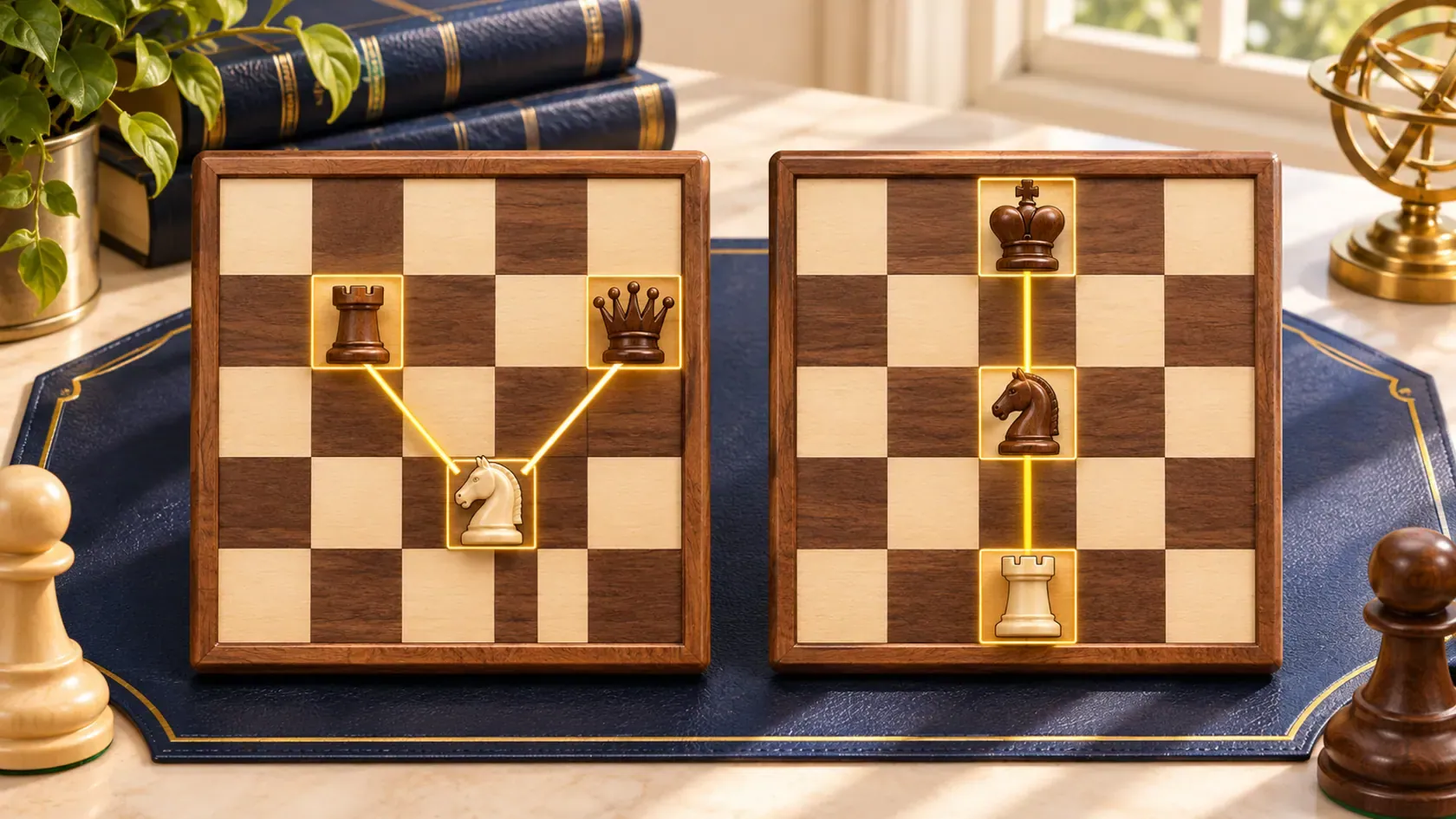
Find the knight fork
White to move: move the knight to attack the king and queen at once.
Select a piece, then select its destination.
These are teaching positions. Explore the explanation after making the move.
Start here
The quick answer
A chess tactic is a short sequence that uses a concrete feature of the position, such as an attack on two targets or a piece that cannot safely move. In a fork, one piece attacks two or more targets at once. A pin restricts a piece because moving it exposes a more valuable piece or king behind it. A skewer attacks a valuable piece first and aims to win a less valuable target behind it. The names are useful after you can explain which pieces are involved.
What makes a chess idea a tactic?
A tactic is a concrete sequence of moves that takes advantage of something already present in the position. That feature might be an undefended piece, a king in check, two targets on the same line, or a defender that has too many jobs. The idea is usually visible on the board and can be checked by calculating replies. A tactic is different from a general plan such as improving a rook or controlling a square. Both matter, but a tactical claim should have a line of moves that explains what happens if the opponent responds.
A beginner can start by asking three questions: Are there checks? Are there captures? Are there immediate threats? Then inspect what the last move changed. A tactic often appears because a piece moved off a line, a defender was exchanged, or a king became vulnerable. Do not look for a named pattern before looking at the pieces. The safe-square trainer begins with a similar habit: see what is attacked and check the destination before deciding. Naming a fork or pin is a way to describe what you found, not a substitute for seeing it.
Forks: one move, more than one target
A fork happens when one piece attacks two or more targets at the same time. A knight fork is easy to demonstrate because the knight can attack pieces that are not on the same line. A check can make a fork especially forceful: the opponent may have to answer the check first, leaving another target exposed. Queens, pawns, and other pieces can also create double attacks. The defining idea is not the attacking piece’s shape; it is that a single move creates multiple threats and the opponent cannot deal with all of them at once.
Suppose a knight moves with check while also attacking a rook. The king must respond to check, so the rook may be lost if there is no counter-threat. Before calling it a winning fork, check whether the rook can move, whether the king can capture the knight, and whether the opponent has a stronger forcing move. On a board, identify which two pieces are attacked to train the visual pattern. Then calculate one reply for each target. The difference between noticing an attack and proving a tactic is the opponent’s best response.
| Pattern | What to look for | Question to calculate |
|---|---|---|
| Fork | One piece attacks two or more targets. | Can the opponent save both targets? |
| Pin | Moving a piece exposes a more valuable target behind it. | What is revealed if the front piece moves? |
| Skewer | An attacked valuable piece stands in front of another target. | What can be captured after the valuable piece moves? |
Pins: a piece is restricted by what stands behind it
A pin occurs when a bishop, rook, or queen attacks a piece that is in front of another target along the same line. If moving the front piece would expose the king to check, the piece is absolutely pinned and cannot legally move away. If the target behind it is a queen or another valuable piece, the pin is relative: moving may be legal, but it could lose material. These distinctions matter. An absolute pin is a rule constraint; a relative pin is a positional or material concern that should be calculated.
A pinned piece can still sometimes capture the attacker, block the line, or move in a way that keeps the king safe. A beginner should not assume that every pinned piece is frozen forever. Trace the attack from the bishop, rook, or queen to the first piece and then to the target behind it. Ask what squares the front piece could move to and whether any of them keep the line closed. In the board above, try placing the rook on the file and trace the line through the queen to the king.
Skewers: the valuable target moves first
A skewer resembles a pin in reverse. A long-range piece attacks a valuable target, and a less valuable piece sits behind it on the same line. The attacked king or queen may have to move, allowing the attacker to capture what was behind. A rook or bishop can create a skewer when the line is open. The pattern is not guaranteed to win material: the front piece may have a safe block or capture, the rear piece may be defended, or the line may not actually be clear.
A good way to tell a skewer from a pin is to ask which piece is more valuable and which one is attacked first. In a skewer, the valuable piece is in front and is forced away; in a pin, the piece in front is restricted because a more valuable target or king sits behind it. This is a helpful memory aid, but still inspect the full position. A learner may find a line that resembles a pattern while missing an escape square. The piece-value guide explains why the target’s relative value affects whether the sequence wins something useful.
Discovered attacks and overloaded defenders
Not every useful tactic is a fork, pin, or skewer. In a discovered attack, one piece moves and uncovers an attack from a piece behind it. If the moving piece also creates a threat, the move can produce two problems at once. An overloaded defender is guarding more than one important target. When the attacker creates a second threat, the defender may not be able to protect everything. These ideas grow from the same board-reading habit: trace lines, count targets, and notice what each piece is defending.
You do not need to teach every pattern in one lesson. Work on one idea until a student can point to the attacking piece, target, and reply. A child might first learn to spot a knight attacking king and rook, then move to a simple pin with a king behind the target. Add skewers after the learner can trace a line and explain why the front piece must move. When patterns are mixed too early, students may guess a label from the picture rather than reason about the position. Start with clarity and build complexity only when the current task is comfortable.
A three-step routine for solving a tactical position
First, identify forcing moves: checks, captures, and threats. Second, list the opponent’s legal or practical replies to your candidate move. Third, evaluate the position after the sequence: what has been captured, what remains attacked, and is either king in danger? This method prevents the learner from stopping at the attractive first move. A tactic is not proved because a queen is attacked; it is proved when the calculation shows that the opponent cannot escape without a material or positional cost that matters.
Write the line in a few moves and explain each reply. If the student proposes a fork, ask what the opponent could move first. If they see a pin, ask whether the pinned piece can capture the attacker. If they find a skewer, ask where the front piece can go and what happens behind it. This creates a conversation around calculation rather than speed. Puzzles can help, but a learner should also revisit tactics from their own games. A real position is less neatly arranged, and the student must discover the pattern without a title telling them what to look for.
Why a puzzle answer can be right but incomplete
Many beginner puzzles are designed around one clear tactical idea, so there may be a forcing solution. In a complete game, the same position may have several reasonable moves, or the tactic may depend on a defensive resource. A puzzle app might accept a line that wins a queen, while the opponent had a check or a perpetual attack after another move. The puzzle teaches a pattern, but it is not a complete substitute for analyzing the whole position. Ask whether the move is legal, whether it leaves the king safe, and what the opponent can do next.
A wrong answer is useful if it identifies the missing step. Perhaps the learner noticed the fork but overlooked the king’s escape, or saw the pin but not a capture that removes the attacker. Return to the exact position and play the opponent’s reply on the board. Then compare the candidate line with a different move. The beginner practice routine includes a way to revisit one difficult position without solving a large number of puzzles in a sitting. Quality of explanation is a better practice note than an impressive streak count.
Build a manageable tactics practice habit
Choose a small number of puzzles around one theme, such as forks, and say the targets before making a move. On another day, study pins and identify what lies behind the attacked piece. Later, mix patterns and ask the student to name the idea only after they see the board. Set aside time to review an actual game position, even if the tactic was missed. There is no universal number of daily puzzles that guarantees improvement. A child’s schedule, attention, and current understanding determine what amount feels useful.
If a puzzle feels too difficult, reduce the number of pieces or use a verbal prompt: “What is attacked?” A coach can show a simpler example and then return to the original. Signa’s online programs use level-based curricula, so families can ask which tactical ideas fit a student’s current experience. A short assessment can help distinguish movement-rule questions from calculation questions. The first chess lesson guide describes what parents can ask during a trial without treating one puzzle answer as a prediction of a future rating.
Keep it practical
What to take with you
- Find the attacking piece and every target before naming a pattern.
- Ask what changes if the pinned or attacked piece moves.
- After spotting a tactic, calculate the opponent’s best reply before taking material.