
Find the chess square
Read the file letter, then the rank number. Select the square that matches.
Square 1 of 6
Your task
Find e4
Match file e with rank 4.
Choose the square named in the task.
White’s files run a–h from left to right; ranks run 1–8 from White’s side.
Start here
The quick answer
A chess square is named with a file letter followed by a rank number: e4 means the square on file e and rank 4. Files run from White’s left to right as a through h; ranks run from White’s side to Black’s as 1 through 8. In algebraic notation, a piece move usually begins with its letter, while a pawn move is written with the destination square. Start by finding squares before trying to read a full game score.
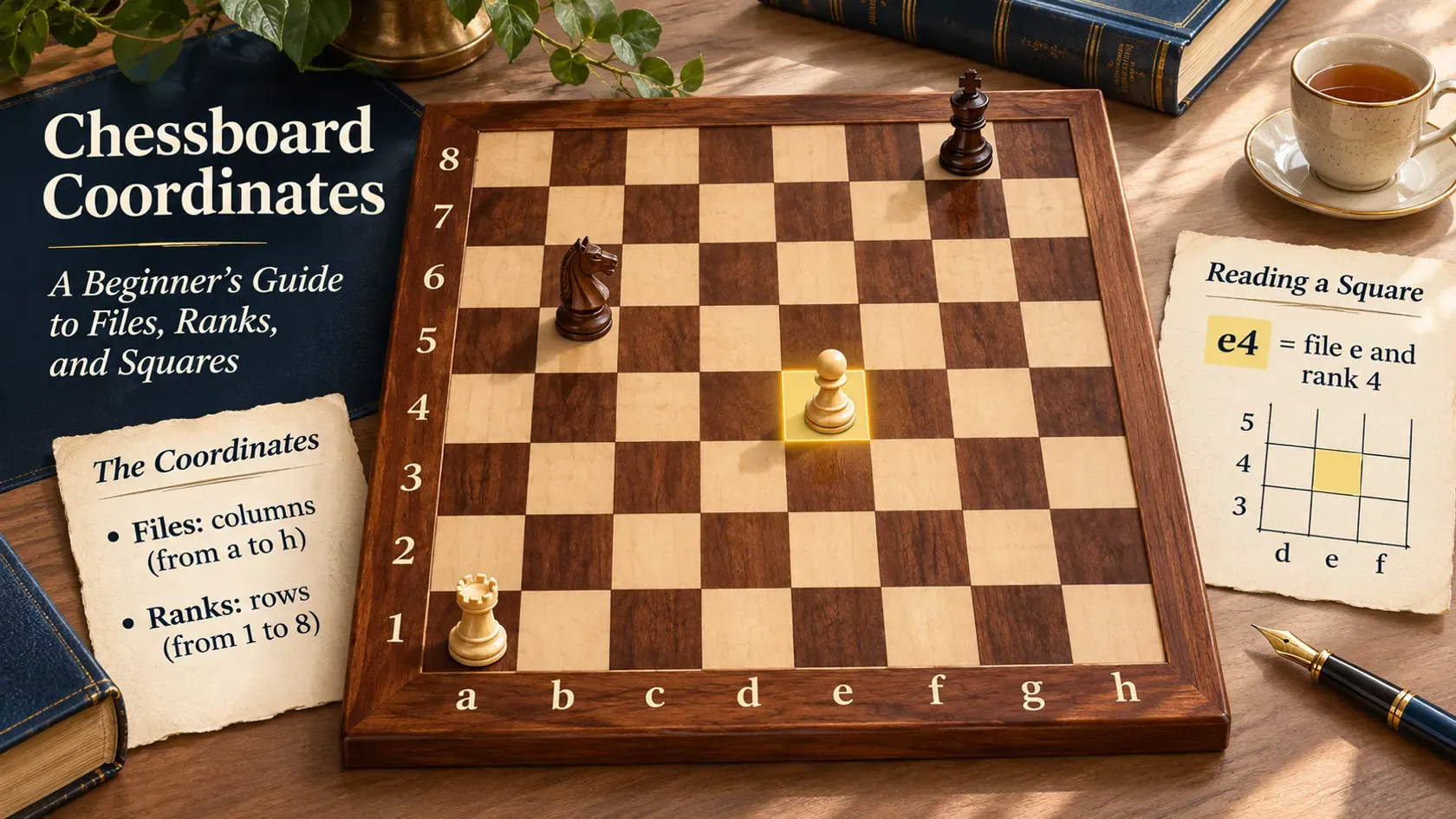
Start with the board’s orientation
Before naming a square, place the board correctly. Each player should have a light-colored square in the corner nearest their right hand. From White’s viewpoint, the files are labeled a through h from left to right, and the ranks are numbered 1 through 8 from White’s side toward Black. The US Chess beginner guide uses the familiar reminder “white on the right” and introduces algebraic notation as a way to record moves. If the board is rotated, every coordinate you read from it will be wrong even when your file-and-rank method is sound.
The letters and numbers describe the board, not the chess pieces. A file is one vertical column; a rank is one horizontal row. The square where file e crosses rank 4 is e4. A square name always places the letter first and the number second. Try pointing to a square and saying its file before its rank. This small verbal routine makes it easier to correct a misplaced finger without telling a learner that they are “bad at coordinates.” The US Chess Learn to Play Chess guide also connects square names with recording moves.
Read a coordinate one part at a time
When you see c6, find the c-file first. Move your eyes to the third vertical column from White’s left, then move up to rank 6. When you see h1, find the far-right file and the rank nearest White. You can reverse the process when reading the board: locate a piece, name the file under it, then name the rank beside it. Saying “file c, rank six” before combining the parts helps students who are still building number and letter fluency.
Coordinate practice is a visual-spatial task as well as a chess task. A young learner may understand that ranks are rows but still lose track of direction after Black’s side is shown at the top. Keep the board from White’s viewpoint at first, and only turn it around after the basic mapping feels familiar. A laptop or tablet gives enough room to see the rank and file labels together. Our interactive square finder above offers short prompts with no timer. The existing guide to how chess pieces move explains the same board labels before applying them to piece movement.
- File: a vertical column labeled a through h.
- Rank: a horizontal row labeled 1 through 8.
- Square: file letter first, then rank number.
Understand the short forms for pieces
In standard English algebraic notation, a move by a piece begins with its initial: K for king, Q for queen, R for rook, B for bishop, and N for knight. The knight uses N because K already represents the king. A pawn move has no piece letter; it is written with the destination square. So e4 can mean a pawn moved to e4, while Nf3 records a knight moving to f3. The exact notation for a move may need an extra file or rank when two identical pieces could reach the same destination.
A move score is normally read in pairs. The first White move is 1.e4; Black’s reply may appear as 1...e5. The number identifies the move pair, the dots distinguish Black’s move when needed, and the text identifies the move. If an article lists 1.e4 e5 2.Nf3 Nc6, White moved a pawn to e4, Black moved one to e5, and then the knights moved to f3 and c6. You do not need to memorize every punctuation mark before following a short beginner example. Learn the squares first, then add one symbol at a time.
| Notation | What it records | What to notice |
|---|---|---|
| e4 | A pawn moves to e4 | Pawn moves do not use a piece letter. |
| Nf3 | A knight moves to f3 | N stands for knight. |
| Bxe6 | A bishop captures on e6 | x marks a capture. |
| O-O | Kingside castling | The zeros describe a special king-and-rook move. |
| + | The move gives check | The opposing king is attacked. |
Follow a short score without getting lost
Choose a game score with a few opening moves and replay one move at a time. Set up the pieces, read the first destination, make that move, and pause before continuing. If the board does not match the next notation, go back to the last move you understood. This is more useful than moving several pieces from memory and discovering that the position no longer makes sense. When reading a digital score, the viewer may highlight the last move; use the highlight to check your understanding, not as a substitute for naming the square yourself.
A student does not have to record every casual game. Notation becomes useful when they want to revisit a position, discuss a tournament game, or follow a lesson. The coach can choose a short fragment and ask what each symbol means. A parent can read a move aloud and let the child find its destination. Keep the activity separate from a timed game until the student can find the squares at a comfortable pace. For a first chess class, explain that notation is one tool for talking about a game—not a gate a beginner must pass before learning chess.
Learn captures, checks, and special moves in context
A capture is commonly marked by x, while a check is marked with a plus sign. A checkmate symbol may appear as # in many modern scores. Castling is written O-O for kingside castling and O-O-O for queenside castling. Promotion records the destination and the chosen piece, often with an equals sign such as e8=Q. These symbols help readers understand what happened, but the board position still determines whether a move is legal. A punctuation mark in a published game can also be an editor’s comment rather than part of the move itself.
The official FIDE Laws of Chess describe how moves are recorded in competitive games, including standard algebraic notation. Tournament procedures can depend on the event’s rules and time control, so families should read the current event instructions rather than assume every scholastic section has the same recording requirement. If your child is preparing for an event, the parent guide to a first tournament covers practical questions to confirm with the organizer. Practising how to write a move at home should make the task feel familiar, not create pressure to become a perfect scorekeeper overnight.
Make notation practice useful for children
Use a handful of squares rather than drilling all 64 in a row. Put a knight on the board, name its square, and ask for one legal destination. Then reverse the activity: say a square and ask the learner to point to it. If the answer is wrong, compare the file first and rank second. That reveals whether the difficulty is with letter order, board orientation, or counting. Give the child time to look at the labels. Speed can come later if it is useful; accuracy and understanding are the first goals.
Try notation after a short game by choosing one memorable move. Ask which piece moved, where it started, and where it ended. Then look up how the move is written. If the student cannot remember the starting square, reconstruct the position rather than guessing. Recording a game can help a coach discuss a decision in a later session, but the conversation should remain about the idea in the position. The weekly practice routine includes a short review habit that can hold one game question without turning every family evening into a lesson.
Common notation mistakes and gentle fixes
The most frequent early mix-up is reversing the square name. A learner writes 4e because they noticed the rank before the file. Remind them to say “letter, then number.” Another is turning the board around and reading the files from the wrong side. Return to White’s viewpoint and locate the light square at the right-hand corner. A third is using K for a knight. Explain that K is already the king’s symbol, so the knight takes N. Use one example at a time; correcting a full page of notation can make a small error feel larger than it is.
A move written without enough information can also be ambiguous in a crowded position. For example, if two rooks can both reach the same square, notation may include the starting file or rank to show which rook moved. This is not a mistake by the player; it is extra information the reader needs. Captures and promotions add their own symbols. A beginner can focus on the destination square and piece first, then learn how notation resolves less common cases while following real games. A coach can select examples that match the student’s current level rather than asking them to memorize the full rulebook notation section.
A simple practice plan for the next week
On the first day, find six called squares on an oriented board. On another day, label the squares occupied by the kings and queens in the starting position. Later, read four half-moves from a short score and point to each destination. Finish by writing one pawn move and one knight move. Keep the activity short enough that the child can stop while it still feels manageable. If the learner is already comfortable with coordinates, skip ahead to replaying a game fragment and explaining what the notation records.
Revisit the same squares after a few days and see which ones now come quickly. That small check tells you whether the method is sticking without turning it into a grade. Bring any confusing example to class so a coach can show it on the board. Signa’s online programs introduce students at different levels, and an assessment can help the academy understand what a learner already knows. Notation should help the student describe their chess thinking; it is not a rating, a measure of intelligence, or a reason to postpone playing.
Keep it practical
What to take with you
- Orient the board with a light square at each player’s right-hand corner.
- Read a square as file first, rank second: b6 is not the same as 6b.
- Learn the move symbols gradually; the event or coach can clarify notation requirements.