
Start here
The quick answer
A chess rating estimates playing strength within one rating system. It is not an age grade, a school mark or a prediction of a child’s potential. Use the rating type and list specified by the tournament, ask the director about section eligibility, and keep learning goals separate from the number.
What a rating is useful for
A parent often first encounters a rating while reading an entry form. The event might offer an Under 800 section, ask for a US Chess ID, or list a student as unrated. These labels can sound like an assessment of the child before they have even sat at a board. A more useful interpretation is administrative and competitive: a rating gives organizers one way to compare past results and arrange appropriate competition. It describes a record in a particular system, rather than defining the player as a person.
At home, use the rating as background information. It can help you and a coach choose positions of a sensible difficulty or discuss whether an event’s format fits the student. It cannot tell you whether the child enjoyed the lesson, can explain an idea, or knows how to recover after a mistake. Those things need observation and conversation. Write down a learning goal alongside the rating, such as checking the opponent’s threat before moving. That gives the next week a useful purpose even when the number barely changes.
Keep different rating systems separate
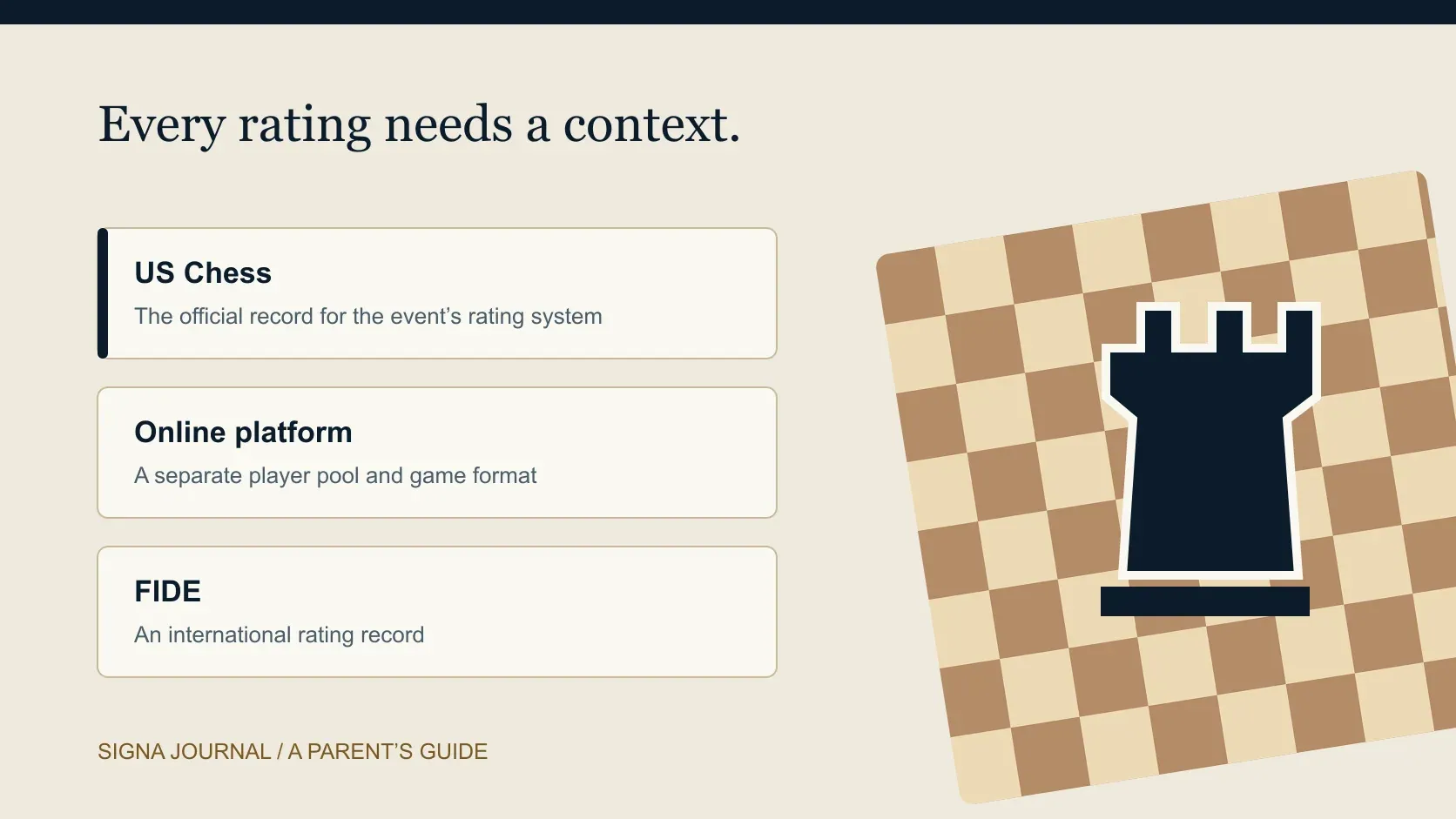
A student can have several ratings at once. US Chess, FIDE and an online playing website maintain different records, and a single service may separate fast and slow games. The opponent pool, game conditions and calculation methods are not identical. A child who says they are rated 1000 has not yet given enough information to choose a tournament section. Ask where that rating comes from, which game speed it describes and when it was recorded. Keep the platform and rating type beside the number in any private notes.
Avoid using an internet conversion chart as permission to enter a section. An organizer may publish a rule about alternate ratings, but that rule belongs to the particular event. Share the student’s relevant playing history and ask the director how it applies. The official US Chess rating specifications describe its calculation system; they do not turn every online website score into the same measure. For a new family, accurately naming the system is more useful than trying to reproduce the calculation.
| Check | Why it matters |
|---|---|
| Rating system | A US Chess, FIDE and website rating are separate records. |
| Game type | Fast games and longer games may have separate ratings. |
| Publication date | The event may require a particular published list. |
| Event rules | The director confirms which record governs section eligibility. |
Understand a first or provisional rating
A new player has little recorded evidence in the system. Early results therefore need to be read cautiously, particularly when a parent is tempted to compare them with a classmate’s long-established record. US Chess explains its publication requirements and provisional status in its first-rating FAQ: a published rating normally requires at least four rated games in the relevant system, and the first 25 games are provisional. Check the official record and current guidance for the student’s actual situation.
The practical lesson is to allow a new record to develop. A child may face unfamiliar opponents, use a clock for the first time, or spend more energy learning the event routine than calculating. None of that means the experience was wasted. After the tournament, ask what felt different from home practice and what the student wants to try again. If you record a number, also record the event and the game type. This prevents a provisional result from becoming a permanent label repeated to teachers, relatives and the child.
Published ratings and event results can differ
A result appearing online and the rating used to enter the next event are not necessarily the same thing. US Chess maintains published lists as well as event-related rating information. Its explanation of published and post-event ratings describes how the publication snapshot can differ from later processing. The event notice should say which list or date it uses. Read that instruction before assuming the most recently visible number controls eligibility.
Make this a simple registration habit. Save the event notice, note the required rating list, check the student’s official record, and ask the director if something is unclear. If the student plays another event before the tournament starts, do not independently decide that a section change is required or unnecessary. Explain the timing and ask for the organizer’s decision. A short, factual message avoids unnecessary arguments based on screenshots from different dates. Keep the response with your registration confirmation so the family can follow the same instructions at check-in.
Choose a section using the event’s own rules
A rating limit is only one part of section choice. A scholastic event may also use school grade, age, residency, title, qualification or separate rules for unrated players. A section called Open does not mean that every related restriction disappears. Equally, unrated does not mean the child must be a beginner. The useful question is whether this student, with this record, is eligible for this section under this event’s published terms. Start with the organizer’s page rather than a general blog answer.
Our guide to choosing a section for an unrated child walks through that conversation. When asking a director, identify the tournament and proposed section, explain whether the student has an official rating, and mention other relevant chess experience. Use the official contact channel for identifying details. Do not post a child’s member number or birthdate in a public group. If the page and registration form appear to disagree, ask the organizer to resolve the difference before paying. The academy can help a family prepare, but it does not decide eligibility.
Talk about changes without making the number the goal
A rating change can be emotionally loud even when the chess lesson is quiet. A student might remember a loss more strongly than several careful decisions they made earlier. Try asking about a position before asking about the new rating: where did they spend their time, which threat did they miss, or what did the opponent do that surprised them? Allow the child to choose whether they want to discuss it immediately. Food, rest and a break may be more useful than a detailed analysis in the tournament corridor.
Be especially careful with rewards that depend entirely on gaining points. They can make the student’s view of a game hinge on an administrative outcome they cannot fully control. Praise specific behavior you actually observed: they returned to the board calmly, recorded moves carefully, or checked a candidate move instead of rushing. This does not mean pretending every game went well. It means separating the result from the response to it. A disappointing event can reveal a clear practice need without becoming evidence that the child lacks talent or should stop playing.
Turn the games into a manageable practice plan
Choose one or two games to revisit once the student is rested. Ask them to explain what they were thinking before opening an engine. Look for a repeatable decision rather than collecting every computer mistake: leaving pieces undefended, moving before checking a threat, or spending too much time on a familiar opening. A coach can help distinguish a missing concept from a moment of distraction. The practice task should match the decision you found, not an arbitrary target rating selected because another child reached it.
For example, if the student repeatedly overlooks an attacked piece, try a few positions where they name all current threats before choosing a move. If they run short of time, discuss when they paused and practise a deliberate routine in a suitable training game. Keep the work small enough to repeat during a school week. Our beginner practice routine connects a lesson, puzzles, a thoughtful game and a short review. The point is to build a habit the student can sustain. Rating results may provide feedback over time, but the practice itself needs a concrete purpose today.
Keep a useful record and know when to ask for help
A parent’s private record can be brief: event name and date, rating system, section, one learning observation and one practical question for next time. Keep membership details and login credentials separately and securely. You do not need a public progress chart or a spreadsheet that compares every student in the class. A short record is easier to use when speaking with a coach or organizer, and it leaves room for the child’s own view of the experience. Ask what they would like to feel more confident doing at the next event.
If a published record appears wrong, collect the relevant event details and contact the tournament director or US Chess through the appropriate official channel. A coach’s lesson recommendation does not correct an official rating report. If you are unsure whether a membership exists or remains active, see our membership guide before creating another account. Keeping the administrative questions with the organization responsible for them makes the process calmer. It also keeps coaching focused on the board: understanding a position, making a reasoned choice and learning something useful from the game.
Keep it practical
What to take with you
- Check which rating system and publication date the event uses.
- Early ratings can move substantially; one result is a small sample.
- Use actual game decisions to choose practice, rather than chasing a number after every event.