
Start here
The quick answer
A child who plays confidently online can feel surprisingly uncertain at a physical board. The rules have not changed, but the surrounding tasks have. The student must orient the board, recognise the pieces from a different angle, notice whose turn it is without a highlighted square, and perhaps use a separate clock. These are practical skills that deserve instruction rather than being treated as evidence that the child does not understand chess.
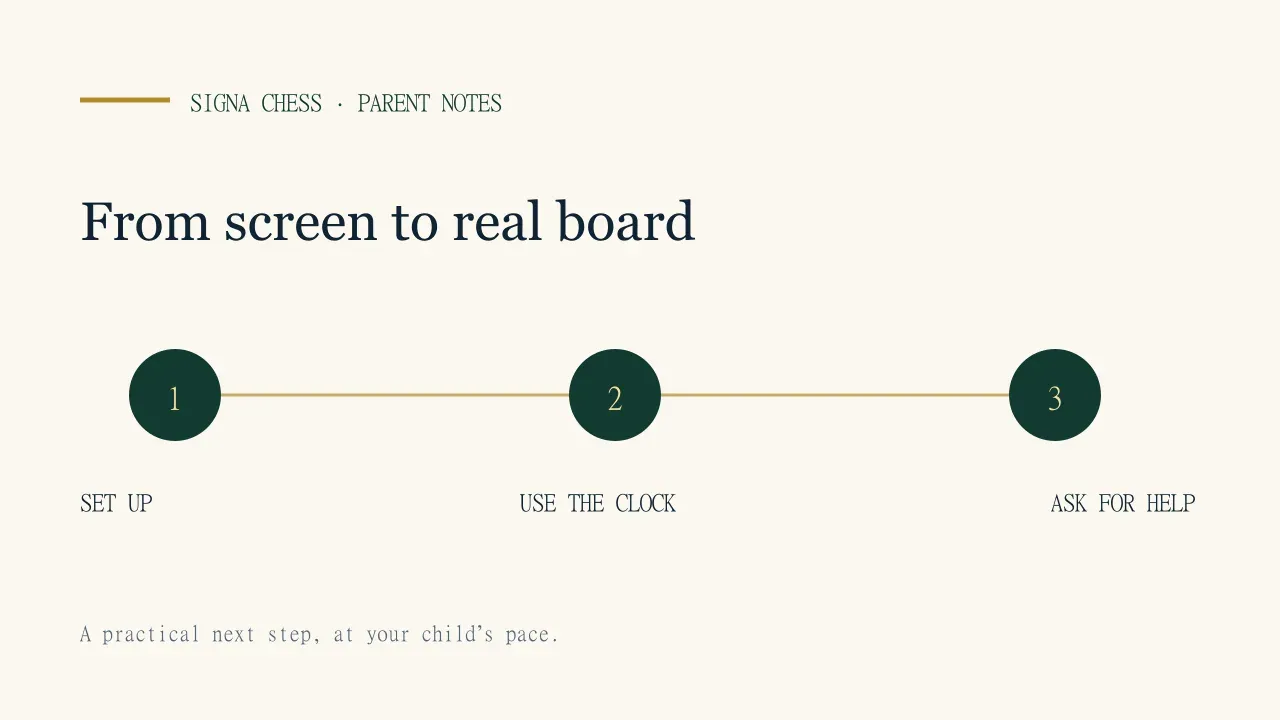
Start by identifying the unfamiliar task
A child who plays confidently online can feel surprisingly uncertain at a physical board. The rules have not changed, but the surrounding tasks have. The student must orient the board, recognise the pieces from a different angle, notice whose turn it is without a highlighted square, and perhaps use a separate clock. These are practical skills that deserve instruction rather than being treated as evidence that the child does not understand chess.
Ask the child to show what feels different. They might struggle to distinguish a bishop from a pawn in an unfamiliar set, or lose track of a long diagonal viewed from a low chair. Adjust the seat, lighting, and board position before adding harder positions. A comfortable view of the pieces can resolve a problem that more tactics training would miss.
Keep early physical-board sessions relaxed. The aim is to transfer an idea the child already understands into another setting. Complete a few familiar moves, then ask them to describe what the pieces attack. Success is being able to use the board deliberately, not reproducing an online rating in the first game.
Set up and check the board together
Place the board so the near right-hand corner is a light square. Put each queen on her own colour, with the white pieces on the first two ranks and black pieces on the last two when coordinates are present. Ask the child to check the kings and queens before starting. Make this a short routine that they can perform rather than a correction delivered only after something goes wrong.
Let the student set up from a diagram as a separate activity. Start with kings and a rook, then add pieces. Ask them to compare files and ranks to ensure the position is not mirrored. When using an online teaching diagram, check which side is at the bottom. A flipped diagram is useful for some lessons but confusing if a beginner assumes every display has White nearest.
If the child notices a setup error, praise the checking action specifically. “You compared the queen’s square with the diagram” identifies a repeatable habit. Avoid making a setup mistake feel embarrassing; experienced players also check boards, clocks, and positions before serious play.
Replay a short game without interface prompts
Choose a short sequence the child understands and replay it physically. Pause after each opponent move and ask what changed. Online interfaces may highlight the last move or show legal destinations; a physical board usually does neither. The student needs a habit for locating the moved piece and noticing the lines it opens or closes. Practise that habit in ordinary positions before using a difficult tactical puzzle.
Remove training aids gradually. If the child needs to trace a bishop’s diagonal with a finger while learning at home, allow the exploration, then ask them to identify the squares without touching pieces. Explain that competition conduct can differ from home practice and that event officials are the source of the applicable rules. Do not turn the first home game into an imitation tournament with every procedural demand introduced at once.
Use the piece-movement guide if a rule needs revisiting. A familiar digital activity can clarify the concept, followed by one physical example to connect the two settings. This is a bridge between formats rather than a test of which format is better.
Introduce the clock as a separate device
Before a timed game, show which side of the clock is running and how a move is followed by a clock press. Practise a few harmless moves without focusing on the result. A child who has only used automatic online clocks may forget to press a physical clock even when their chess decision is sensible. Treat that as a new routine that needs practice.
Check the actual event time control before configuring a training clock. Increment and delay are different mechanisms, and the precise setting matters. Ask an organiser or experienced official if the notation is unfamiliar. The purpose of a home rehearsal is to make the device understandable, not to teach an incorrect setting with great confidence.
Avoid beginning with extremely short games to make the experience exciting. A student learning the clock, board view, and move procedure may need more thinking room. Choose a relaxed setting and practise completing the move-and-press sequence calmly. Discuss clock decisions separately from the technical assessment of the game.
Learn notation in small pieces
If the relevant event requires recording moves, start with naming squares and reading a short sequence. Then ask the child to record a few moves from a friendly game. Check the record together before trying to write every move at competition pace. Notation is a way to preserve the game for later discussion; learning it should help the child understand the board rather than become a separate source of avoidable pressure.
Ask the organiser what recording requirements apply to the event, age group, and time control. Do not assume that all junior competitions use identical procedures. If a child has a practical access need, discuss it with the organiser ahead of time. A parent should not invent an accommodation during a round or coach the child from the playing area.
Our notation guide provides examples and practice. Use one short section at a time, then return to the physical board. A readable partial practice record is more useful than pages of copied notation that the child cannot connect with actual moves.
Rehearse asking an official for help
A new player should know that uncertainty about a rule or procedure can be brought to an official. Ask the event organiser how a junior should request help during a game. Rehearse the wording at home: “I need help with the clock,” or “I am not sure what to do in this situation.” The child does not need to solve every procedural dispute alone.
Also discuss what the parent’s role will be. At many competitions, parents cannot give chess advice during a game. Confirm the event’s arrangements for watching, waiting, collecting children, and reporting concerns. Agree where you will meet after the round. Knowing the practical routine can make the first event more manageable for both parent and student.
Keep rules instruction separate from criticism of opponents. If a situation felt unfair, listen, preserve the relevant details, and follow the organiser’s process. Avoid encouraging the child to argue chess claims with another junior. The useful skill is recognising when to ask an authorised adult for help.
Choose a first event with confirmed details
Before entering, verify the venue, date, age categories, rating sections, membership requirements, time control, and supervision directly with the organiser. Directories are discovery tools and may not reflect the latest change. A listing is not proof that registration remains open or that a particular section suits your child. Keep the official event page and confirmation accessible on the day.
Signa’s tournament directory focuses on USA events. Families in other countries should use the appropriate national or local chess organisation and the event organiser. The same planning questions remain useful, but membership and rating systems differ. Read the first-event planner for a practical checklist, then verify each event-specific answer.
If the child understands online play but needs help making the transition, describe the exact task when requesting a live assessment: physical setup, clock use, notation, or reviewing a recorded game. The coach can discuss the existing tournament preparation offer where appropriate. A useful plan supports the next real experience without promising a result or assigning an official rating from a few exercises.
A rehearsal evening before entering an event
Set aside a relaxed evening to try the practical sequence. Let the child set up the board, find their colour, check the clock if one is being used, and play a short friendly game. Pause to ask what they would do if a piece were accidentally displaced or if they did not understand an instruction. Use the organiser’s guidance for procedural questions rather than inventing rules to make the rehearsal feel official.
Afterwards, ask which physical task felt unfamiliar. If the child forgot to press the clock, repeat only that sequence for a few moves. If the scoresheet was confusing, record a short line together. If they found the board hard to see, change the chair or lighting. Solving the specific practical difficulty is more efficient than replaying a whole evening with the same frustration. Keep the rehearsal separate from a judgment about competitive readiness. Ask the child what they would like to try again on another day.
Prepare a small parent note with the venue, arrival instructions, organiser contact, collection arrangements, and the questions still unanswered. Check equipment requirements against the event information before packing. A directory may help discover the event, but the official confirmation should guide the actual day. The child’s job is to play and ask for help appropriately; the parent’s job includes making the surrounding logistics manageable. Those roles can be rehearsed together without adding pressure to win.
Keep it practical
What to take with you
- Observe a specific learning need before choosing a course.
- Use a short board activity or a recent game to guide the conversation.
- Confirm the course, timetable and payment arrangement before joining.