
Start here
The quick answer
When a child comes out of a chess game upset, the immediate job is to make the next few minutes manageable. You do not need to identify the losing move in the corridor. Offer water, somewhere quieter to sit, or a short walk. Ask whether they want company or a little space. Some children want to tell the whole story immediately; others cannot yet explain what happened. Both responses leave room for a useful chess conversation later.
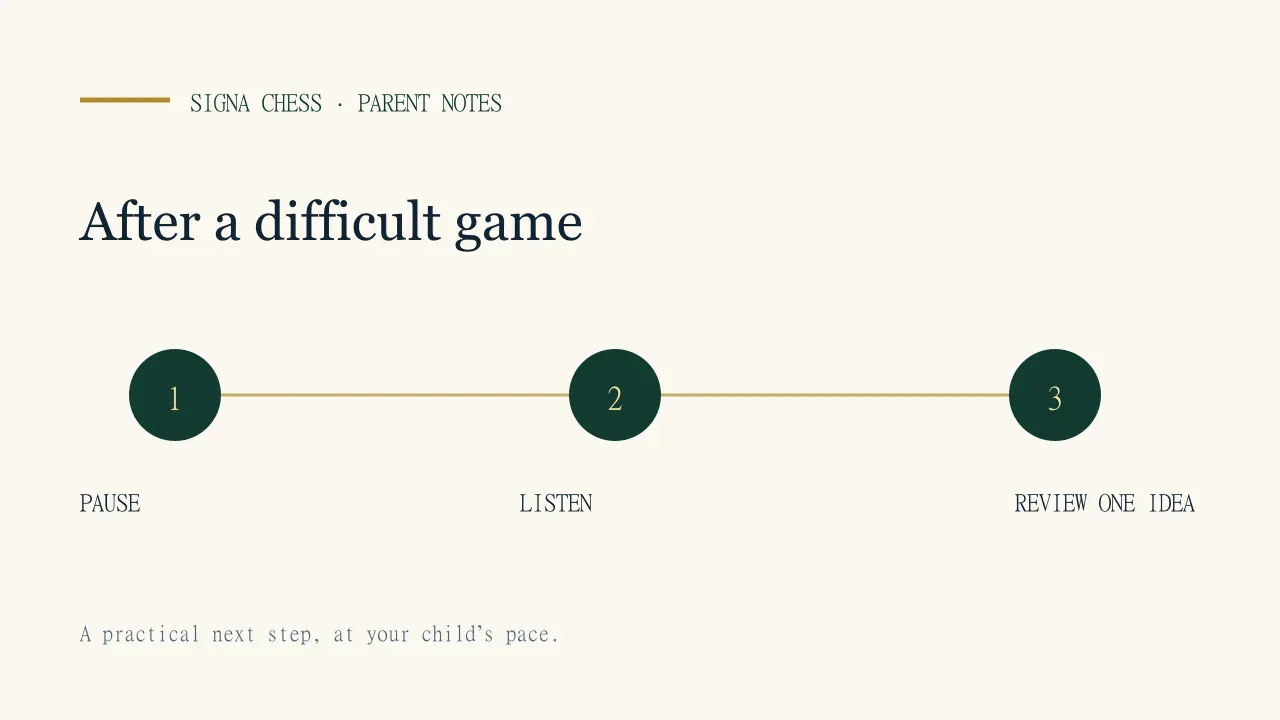
Start with the child rather than the scoresheet
When a child comes out of a chess game upset, the immediate job is to make the next few minutes manageable. You do not need to identify the losing move in the corridor. Offer water, somewhere quieter to sit, or a short walk. Ask whether they want company or a little space. Some children want to tell the whole story immediately; others cannot yet explain what happened. Both responses leave room for a useful chess conversation later.
A simple sentence is often enough: “That was a difficult game. I am here when you want to talk.” Avoid promising that the opponent was lucky or that your child deserved to win. You may not know the position, and those explanations can distract from learning. Equally, avoid turning a loss into a lesson about working harder before the child has recovered. A child can care deeply about a result without being ready to analyse it.
Your response does not have to make disappointment disappear. It should make clear that a result does not change your support. If the child asks to stop talking about chess for the journey home, agree a later opportunity rather than continuing to ask questions. The board will still be there tomorrow.
Separate feelings, conduct, and chess decisions
Three different conversations can follow a loss. The first concerns feelings: frustration, embarrassment, disappointment, or tiredness. The second concerns conduct: how the child treated the opponent, equipment, and officials. The third concerns chess: what the position required. Mixing all three can make the child hear “You played a bad move” as “You behaved badly” or “You disappointed me.” Keep the topics separate and use concrete descriptions.
For example, “You were upset after the game” describes a feeling. “The pieces need to stay on the board” sets a boundary about conduct. “Let’s check what the rook was attacking” introduces chess. A child can be upset and still behave respectfully; a calm child can still need help with sporting conduct. Discuss any urgent behaviour briefly, then postpone the detailed game review until the situation is settled.
Do not require a cheerful performance for the adults watching. Respectful behaviour matters, but children do not have to pretend that a meaningful loss feels good. If distress repeatedly interferes with ordinary activities, discuss the wider pattern with someone appropriately qualified rather than treating more chess practice as the solution.
Choose a review time together
Ask a small, answerable question: “Would you like to look at one position tonight or tomorrow?” This gives a choice without making the child responsible for designing a training programme. Keep the first review short. If another tournament round starts soon, a snack, the next pairing, and a bathroom break may matter more than a full analysis. A technical explanation that arrives at the wrong moment can increase the load rather than help.
When the child is ready, begin with their account before checking an engine. Ask where they felt comfortable and where they became unsure. Let them show a move they liked. This makes the review a reconstruction of a game they actually played, instead of a list of errors supplied by a stronger adult. If a scoresheet is incomplete, use the position the child remembers and acknowledge uncertainty.
Agree a stopping point before starting: one position, one alternative, and one idea to remember. A review can be successful without explaining the entire game. Younger children may prefer moving the pieces physically while telling the story; older students may want to write down a question for their coach.
Use a three-question review
At the chosen position, ask: “What changed after their last move?” Then ask: “What were you trying to do?” Finally ask: “Which other move could you consider?” These questions distinguish noticing a threat, choosing a plan, and comparing options. A child who overlooked an attack needs a different exercise from a child who saw the attack but miscalculated a capture. The final score alone does not tell you which difficulty occurred.
Let the child make the alternative on the board and play one natural reply. If they suggest a move that is illegal, return to the rule calmly. If two moves look reasonable, do not invent certainty: write down the position for a coach. You can say “I do not know yet” while still helping the child organise their thinking. This is especially useful when a parent is learning chess alongside the student.
Record the learning point as an action: “Check the opponent’s rook before moving the queen,” rather than “Be more careful.” Actions can be practised and observed. General instructions are difficult to use when a child is already trying hard.
Match the next activity to the actual mistake
If a piece was left undefended, practise noticing attacks on a small board position. If the clock caused a rushed finish, play a relaxed training game with a visible clock and discuss when to pause. If a misunderstood rule ended the game, replay that rule with a few pieces. Avoid assigning a large batch of unrelated puzzles as a response to disappointment. The practice should make the next decision clearer, rather than feel like a penalty.
For a young beginner, a useful session might last five minutes: put a rook and a king on the board, ask what the rook attacks, move it, and ask again. For an experienced junior, compare two candidate moves from the actual game and calculate a short reply to each. Difficulty should follow the demonstrated problem. Age alone does not identify the right exercise, and an online rating may not explain a particular error.
Our piece-safety guide offers board activities for missed threats. Use it when that matches the game, and stop after a clear example. A lesson is more useful when the child can explain the idea than when a long task list is completed mechanically. Our weekly practice routine shows how to fit a short exercise, a thoughtful game and a brief review into a school week.
Keep a parent response checklist
Before speaking about the result, ask yourself whether the child has eaten, rested, and had a chance to describe the experience. Check whether your question is genuinely open or whether you are asking the child to agree with your analysis. “Why did you do that?” can sound like an accusation even when you intend curiosity. “What did you notice here?” usually leaves more room for a useful answer.
Notice effort precisely. “You stayed with a difficult position and asked the arbiter when you needed help” is grounded in something that happened. “You are a genius” and “You always throw games away” both turn a single experience into an identity. Neither gives the child a decision they can repeat. Keep praise, correction, and planning tied to observable behaviour rather than broad judgments about talent.
Compare your response after a win. If the only long conversations happen after losses, the child may learn to expect a problem whenever you ask about a game. Invite explanations after enjoyable games too. A good move, a resourceful defence, and an interesting draw all deserve curiosity.
- Offer a break before analysis.
- Ask permission to review one position.
- Name one repeatable decision habit.
- Agree when to play again.
Bring patterns to the coach
One loss rarely justifies changing the whole training plan. Several games showing the same difficulty are more informative. Bring two or three examples to a coach and describe the surrounding conditions: was the child tired, under time pressure, unsure of a rule, or worried about the result? Include games they enjoyed as well. This helps the coach distinguish a recurring chess gap from an isolated difficult day.
Ask for a small next step and a way to recognise improvement. A useful target might be noticing an opponent’s direct threat in several slow games, or recording enough of a game to review a key position. Avoid making a specific rating gain the condition for considering coaching worthwhile. Ratings depend on the games played and the rating system; they are not a complete measure of learning or confidence.
Signa’s free skills check can provide examples to discuss, while a live assessment lets a coach observe explanation and board use. Neither should be used to label a child after a disappointing tournament. Choose the conversation when it is likely to help.
An example of a calm next-day conversation
Imagine the child says they were winning until a rook disappeared. Start by asking them to reconstruct that moment, rather than announcing that they should have checked every threat. Let the child place the pieces they remember. If the position is incomplete, acknowledge that the example may not be exact. Ask which piece moved last and what that move attacked. The conversation can still teach a checking habit without pretending to reproduce an uncertain game perfectly.
If the child finds the attack now, ask what might help them notice it during play. They might suggest looking at the opponent’s piece before choosing their own move. Try that in two short positions, then stop. Write the habit in a few words on a practice note, without making it a demand that the child never miss another attack. The purpose is to give them a usable response to a familiar difficulty.
End with a choice about the next enjoyable chess activity: a friendly game, a small puzzle, or showing the idea to the coach. If the child does not want another chess activity that day, respect the break and agree when to revisit the question. This example is an illustrative parent conversation, not a customer account or a promise about how every child responds.
Keep it practical
What to take with you
- Observe a specific learning need before choosing a course.
- Use a short board activity or a recent game to guide the conversation.
- Confirm the course, timetable and payment arrangement before joining.