
Start here
The quick answer
Before each round, check the section, round, board number, opponent and color on the official pairing. Follow the organizer’s round schedule, practise the event’s clock settings beforehand, and ask a tournament director when a rule or result is unclear. A first loss does not normally eliminate a player from a Swiss event.
Know the event format before the first round
The first tournament can involve a surprising amount of information away from the board. Parents are finding a room, students are looking for their names, and an organizer may be making announcements while a registration line is still moving. Reading the event notice at home takes pressure out of that moment. Find the section, number of rounds, intended start times and pairing publication method. Save the organizer’s link rather than relying on a forwarded screenshot that could be out of date by the time the family arrives.
Many scholastic events use a Swiss format: students continue through the rounds, with later pairings generally influenced by their scores. It is not normally an elimination bracket where one loss ends participation. Other formats exist, so confirm what your event actually uses. The US Chess guide to scholastic chess explains common tournament organization. For the family, the key action is straightforward: do not leave after a disappointing game without checking the remaining schedule and telling the organizer if the student is withdrawing.
Read the correct pairing sheet
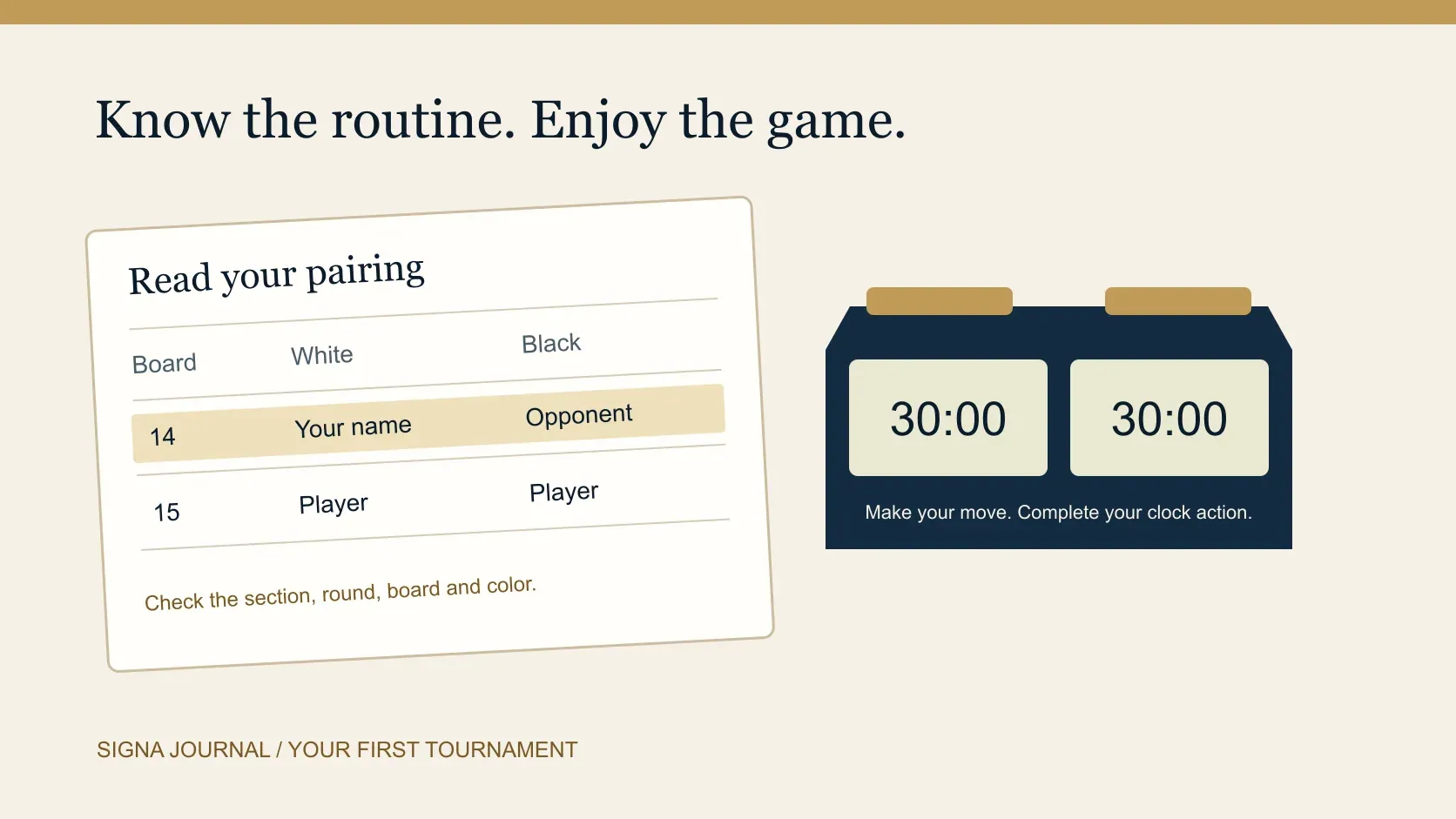
First check the heading. Is it the right tournament, section and round? Large events can publish several sheets that look almost identical. Then locate the student’s name and read across the row. Identify the board number, the opponent and which player has White or Black. A board number describes where to sit; it is not the child’s ranking or score. Make sure the student knows which side they are playing before reaching for pieces. If the name is missing or an opponent is unexpected, ask the event staff rather than switching seats independently.
A printed example can make this routine familiar. At home, write a made-up row with two names and a board number, then ask the student to identify their color and seat. Change the row for another round. Use clearly fictional practice names in your home exercise so no one mistakes it for an actual pairing. This rehearsal takes little time and can be more helpful than another opening variation. On event day, check the final official version: pairings can be corrected, and an earlier photo may no longer be the sheet the director expects players to follow.
| Example field | What to check |
|---|---|
| Section: K–6 Under 800 | Does this match the student’s registered section? |
| Round: 2 | Is this the current round, rather than a previous sheet? |
| Board: 14 | Find table or board 14 in the correct playing area. |
| White / Black | Find which column contains the student’s name. |
Understand byes and changes in the schedule
A bye means that a player does not have a game in that round. Why it happened and what score it carries depend on the situation and event rules. It might be a pairing bye, a requested absence or something handled by the organizer in another way. Do not assume that one event’s bye policy applies to the next. Read the published request deadlines and ask the director what the entry means for the student. A missing game is not automatically a registration mistake, but it should be understood before the next round begins.
Keep the day’s schedule realistic. Some events publish fixed round times; others begin a later round after games in the section finish. A quick first game therefore does not always mean the next round begins immediately. Ask how announcements are made and where families should wait. Choose a place to meet the child that does not interfere with the playing area. Before leaving the venue for food, confirm when the student needs to return. An adult should manage these logistics so a young learner can concentrate on the chess routine rather than repeatedly checking a phone.
Decode the time control before setting a clock
A time-control label explains the playing time, not the full length of the tournament day. In a simple G/30 game, each player starts with 30 minutes for their own moves. The two clocks do not count down together. Other controls include multiple periods, delay or increment. For example, d5 indicates a five-second delay before the main time counts down on a turn, whereas +5 describes a five-second increment added according to the clock’s increment mode. Use the event’s complete notation and instructions when selecting a setting.
Practise on the model of clock the student will use, if it is available. Show which button stops their time and starts the opponent’s, and how to recognize whose clock is running. Do not change a tournament clock yourself to resolve a dispute. Ask the director for help. The current US Chess free rulebook chapters provide the relevant rules; the organizer identifies any applicable event procedures. A child does not need to learn the settings menu by memory to understand the essential routine: make a move, complete the clock action, and watch the board.
Rehearse a calm move and notation routine
Before the event, ask whether notation is required in the student’s section and what equipment is supplied. Requirements can depend on the time control, section and applicable rules, so do not promise that every young child is exempt or that every game must be written down. If the student needs notation, practise slowly at home with a scoresheet. Make the task recognizable: record the move in the correct column, keep the move number aligned and leave room to ask for help when something becomes unclear.
Use practice to connect the physical actions without rushing them. Set up a legal game, put the clock in the correct place and let the student try the event routine. Avoid teaching a last-minute trick or an informal family rule that conflicts with tournament play. If you are uncertain about touch-move, recording moves or handling an irregularity, check the published rules and ask the director beforehand. Our tournament packing guide helps separate equipment the organizer requests from items the family merely assumes are needed. Familiarity is the goal of rehearsal, not perfection.
Teach the student how to ask for help
A young player should know that a tournament director is available for questions during play. Explain how to request assistance without asking a parent to decide a chess dispute from outside the playing area. If something is wrong with the position, clock or procedure, the student can alert the director and describe what they noticed. Practise a plain sentence at home: 'I think the clock is not working correctly. Could you help?' The student should follow the director’s instructions about the clock and position while the issue is considered.
Parents can make this easier by learning the organizer’s policy for spectators and the playing room. Watching a game is not permission to point out a threat, suggest a move or resolve a claim. Arrange a meeting place and allow the child to use the event’s support process. Afterwards, ask what happened in a calm, factual way if there was a difficulty. Avoid turning a disagreement into a public discussion of another child. The purpose is to help the student feel capable of navigating an unfamiliar setting with the officials responsible for it.
Check and report the result together with the opponent
At the end of a game, students should understand how the event expects a result to be reported. A common results notation is 1–0 for a White win, 0–1 for a Black win, and ½–½ for a draw. Those symbols refer to the game’s colors, not to the order in which children are standing at a results desk. Before submitting anything, the players should agree what happened and follow the organizer’s reporting procedure. If they disagree or are confused, ask a director instead of guessing.
Check the next published score or pairing when appropriate and contact staff promptly if a result appears to have been entered incorrectly. Do not assume a parent’s handwritten note changes the official record automatically. Keep the practical conversation separate from the emotional one: first make sure the correct result reaches the organizer, then give the student time to rest and talk about the game. A quick loss, a long draw and a tiring win can all leave a child needing a break before analysis. The next round is easier to approach when the administrative step is settled.
Build a small between-round routine
Agree a repeatable sequence with the student: report the result, meet the adult, have water or food as needed, rest, and check when the next pairing will appear. Leave enough time to return calmly. A family does not need to analyze every move between rounds, and a new opening lesson can add more noise than value. Ask whether the child wants a short conversation or a break. If they bring up a position, listen to their reasoning before giving a correction. Keep one useful observation for a later lesson rather than trying to repair the whole game in the hallway.
After the event, ask which part of the day still felt unfamiliar. You may discover that finding the right room or using a clock was harder than any position. That tells you what to rehearse before the next tournament. Our first-tournament guide covers choosing the event and preparing the family; our guide to section choice for an unrated child covers eligibility questions. A useful next step might be another event, a little practice or a conversation with a coach. It does not have to be an immediate commitment to a larger competition.
Keep it practical
What to take with you
- Use the latest official pairings for the correct section and round.
- A clock’s starting time, delay and increment describe different settings.
- Players should know how to request a director’s help and report the agreed result.