
Start here
The quick answer
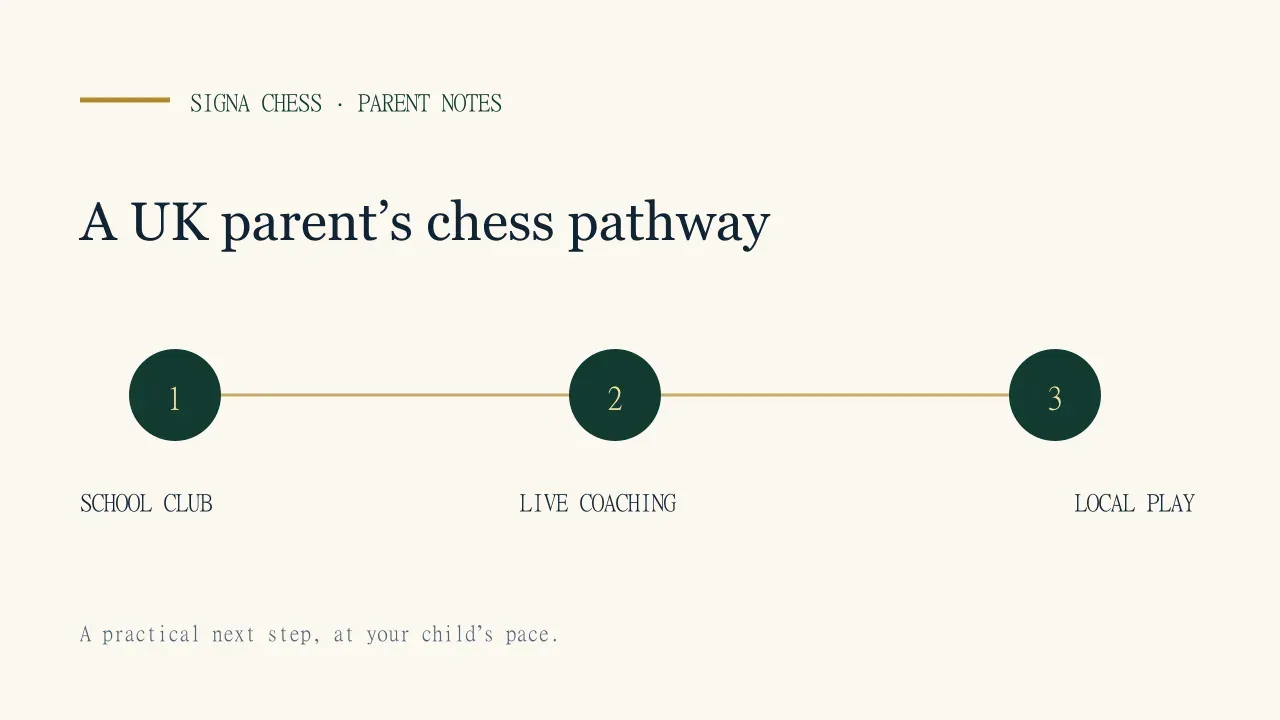
A school club, a local chess club, and an online lesson can serve different purposes. A child may enjoy playing friends at school but want help understanding why a game changed. Another child may know the rules but need a welcoming place to play more slowly. Begin with that need before comparing packages. Coaching does not have to replace a school activity that the child enjoys, and joining a club does not automatically mean that formal lessons are required.
Decide what you want lessons to add
A school club, a local chess club, and an online lesson can serve different purposes. A child may enjoy playing friends at school but want help understanding why a game changed. Another child may know the rules but need a welcoming place to play more slowly. Begin with that need before comparing packages. Coaching does not have to replace a school activity that the child enjoys, and joining a club does not automatically mean that formal lessons are required.
Ask the child for one example. “I want to stop losing my queen” is a useful starting point. So is “I want someone to explain the games I play at school.” For a complete beginner, the goal might simply be moving the pieces confidently and recognising check. Keep the first objective small enough to observe during a trial, instead of starting with an ambitious rating target.
UK families should also separate location from delivery. A live online course can serve a family in Britain without operating a local classroom. Check how lessons are delivered, who handles parent communication, and how a session is confirmed. Do not infer a nearby teaching centre from a regional landing page.
Treat the UK as more than one federation
The English Chess Federation is a starting point for information about organised chess in England. It should not be treated as a single membership authority for every UK event. Scotland, Wales, and Northern Ireland have their own chess organisations and event arrangements. The appropriate organiser can explain what applies to the specific competition your child is considering. This distinction matters when a guide casually refers to “UK ratings” or “UK membership.”
Use the English Chess Federation website for England-specific information and follow the links appropriate to your event. A family travelling across a border should ask about eligibility and rating treatment before paying. Avoid relying on a membership price quoted in an old article. Costs, categories, and event rules can change, and a school competition may have different arrangements from a weekend congress.
This guide explains questions to ask rather than replacing an organiser’s conditions. Signa does not issue federation memberships or official ratings through its free skills check. A coaching recommendation and an official competition record have different purposes.
Ask the school club four practical questions
Before adding another activity, ask the school who supervises the club, what experience levels attend, whether sessions include instruction, and whether children can play complete games. A club built around free play can be valuable, but it may not provide individual feedback. A taught club may follow a curriculum that an outside coach should know about so the child is not asked to learn conflicting terminology or too many new ideas at once.
Ask how families hear about progress or events. Some clubs are informal lunchtime activities; others organise matches or enter competitions. Find out whether participation is optional, how travel and supervision work, and who makes the decision that a student is ready. Do not assume that being invited to a club means being entered into an external tournament.
Share one or two relevant school experiences with the coach. A child who enjoys explaining moves to a friend may respond well to a small group. A child who is worried about being watched may prefer a quieter introduction. These observations are often more helpful than a general description such as “bright but distracted.”
Understand what an ECF record does and does not show
An official rating is based on eligible reported games within a rating system. It is not an assessment of a child’s personality or a conversion of their puzzle score. When a parent supplies a rating to a coach, include the system and format. Also mention how recently the child has played. Two students with similar numbers can have different gaps in opening understanding, calculation, clock use, or confidence over the board.
The ECF maintains an official rating site. Check records there rather than assuming that an online platform number is equivalent. For event entry, ask the organiser which rating list or category they use and how they place an unrated player. If a child has no published record, explain their actual playing experience and ask for guidance.
A coach can use a few games to understand decisions that a rating cannot describe. Save a recent game the child remembers, including a win if possible. The discussion should identify what to practise next, not turn a single number into a fixed level of ability.
Plan lessons using Europe/London
When agreeing a recurring online class, specify Europe/London and the actual date. The UK uses GMT in winter and BST in summer. Writing “6 pm GMT” for a summer session can create an hour of confusion if the intention was six in the evening on the family’s clock. Calendar software using a named time zone can represent seasonal changes more clearly than a fixed UTC offset.
The UK government clock-change page explains the national change dates. An international coach may live somewhere with different changes or none at all. Ask whether the recurring lesson follows the family’s local time or the instructor’s local time, and check the calendar invitation around transitions. A one-off appointment needs an unambiguous date and zone as well.
Signa’s booking request lets a parent choose a time zone. The enquiry itself does not reserve a session. Where a configured calendar is available, its booking flow must be completed to reserve an available appointment. If no confirmed slots are published, the team arranges a time by email rather than displaying assumed availability.
Read GBP figures together with the billing terms
A pound symbol alone does not tell you whether an academy charges in pounds. Ask whether the figure is a fixed GBP tuition rate, an estimated equivalent of another currency, or a payment-provider conversion. Also ask whether a quoted amount is per student, per session, per month, or per block. Comparing a monthly package with a single-session rate without checking the unit can make two very different offers look similar.
Signa’s UK group rates are fixed GBP amounts: £20 for Beginners, £30 for Post-Beginners, £35 for Intermediate and £40 for Advanced, per student per session. The UK class page explains these rates alongside the existing course details. Private coaching and specialist programmes are quoted separately in GBP. Confirm the final payment arrangement before joining, including any payment-provider fees.
Read inclusions just as carefully as price. Ask whether game review is part of the course, how group placement is decided, and what happens if a timetable is unsuitable. Avoid assuming that tournaments, federation fees, equipment, or extra private sessions are included unless the offer explicitly says so.
Choose the first event around a manageable experience
For a first competition, ask about the number of rounds, time control, breaks, supervision, scoring, and help for inexperienced players. Check the event’s age cut-off rather than guessing from a name such as “under nine.” Ask how an unrated entrant is placed and whether any membership or identification is required. Keep the organiser’s written answer with the entry confirmation so both parent and child know what to expect.
Practise ordinary board habits before the day: setting up correctly, recognising whose turn it is, using a clock if needed, and asking an official for help. A child can know many tactics online but still be unfamiliar with the physical routine. Our first-tournament guide offers planning questions, while the actual organiser remains the authority on the event’s rules.
If lessons are the next step, bring one concrete goal to a free live assessment. The academy can discuss suitable group or individual coaching using the existing curriculum. The most useful first decision is whether the child can participate comfortably and understands the next learning task, not whether the first meeting produces an impressive label.
A checklist for the first coaching enquiry
A short parent message can contain enough information to start: “My child plays at a school club, knows ordinary moves, and is unsure about checkmate. We are in Manchester and would like to discuss a group after school.” There is no need to guess an ECF number for a child who has not played rated games. If there is a published record, state the system and include the relevant player reference only through the academy’s appropriate contact process.
Before accepting an offered place, ask for the session duration, group size, learning level, assigned instructor, and total payment arrangement. Ask how to contact the team about a missed lesson and what the student should prepare. These questions reveal the actual delivery better than a page of broad claims about improving concentration. Keep the written reply so the family can compare the offered arrangement with the published course details.
Finally, check the first appointment in Europe/London on the actual date. Ask whether a recurring class stays at that local time when clocks change. If the tutor proposes a different zone, request a calendar invitation that displays the corresponding local time. The fact that a price is shown in pounds does not establish how a class is scheduled or billed. Those details should be confirmed separately before enrolment.
Keep it practical
What to take with you
- Observe a specific learning need before choosing a course.
- Use a short board activity or a recent game to guide the conversation.
- Confirm the course, timetable and payment arrangement before joining.